
The Ultimate Gorilla trekking guide
Gorilla trekking in Uganda is one of the most extraordinary wildlife experiences available anywhere in Africa. It is very different from a traditional safari, where wildlife is normally observed from the comfort of a vehicle. To see mountain gorillas, you have to enter their world on foot. You walk through tropical rainforest, follow paths across steep mountain slopes, cross streams and push through thick vegetation with experienced trackers until, somewhere deep inside the forest, you encounter a family of wild mountain gorillas.
There is usually a remarkable change in atmosphere when the gorillas are finally located. The conversation stops, cameras are prepared and the group follows the ranger quietly through the vegetation. Sometimes the first gorilla you notice is a young animal climbing through the branches. On another trek it might be an enormous silverback sitting quietly on the forest floor, pulling vegetation toward himself and eating with almost complete indifference to the humans watching nearby. A mother may carry an infant against her body while juveniles wrestle, climb trees or chase each other through the undergrowth.
Nothing is staged. The gorillas are not captive animals and they are not trained to perform for visitors. They move freely through the forest, choosing where they feed, rest and travel. This is what makes gorilla trekking so powerful. For a short period, humans are allowed to enter the natural environment of one of our closest relatives and observe their lives at remarkably close range.
Uganda is one of the world's most important destinations for mountain gorilla trekking. The experience takes place in two protected areas in the south-west of the country: Bwindi Impenetrable National Park and Mgahinga Gorilla National Park. Bwindi is the better known of the two and contains several different gorilla trekking regions, while Mgahinga forms part of the dramatic Virunga volcanic landscape shared by Uganda, Rwanda and the Democratic Republic of Congo.
Planning a gorilla safari, however, involves much more than simply deciding to visit Bwindi. Our guests need to understand gorilla permits, trekking sectors, weather, accommodation, fitness, transportation and the amount of time required. They also need to decide whether they want to combine gorillas with chimpanzees, traditional game viewing, Rwanda, Kenya or Tanzania.
This comprehensive Uganda gorilla trekking guide has been created to answer those questions and help travellers understand exactly what to expect before they arrive.
At Buutu Safaris, we believe that a successful gorilla safari begins long before you enter the forest. The right gorilla permit needs to be matched with the right trekking region, the right accommodation and a realistic safari route. When those pieces are planned properly, the gorilla trek becomes the highlight of a much larger journey through one of Africa's most diverse wildlife destinations.

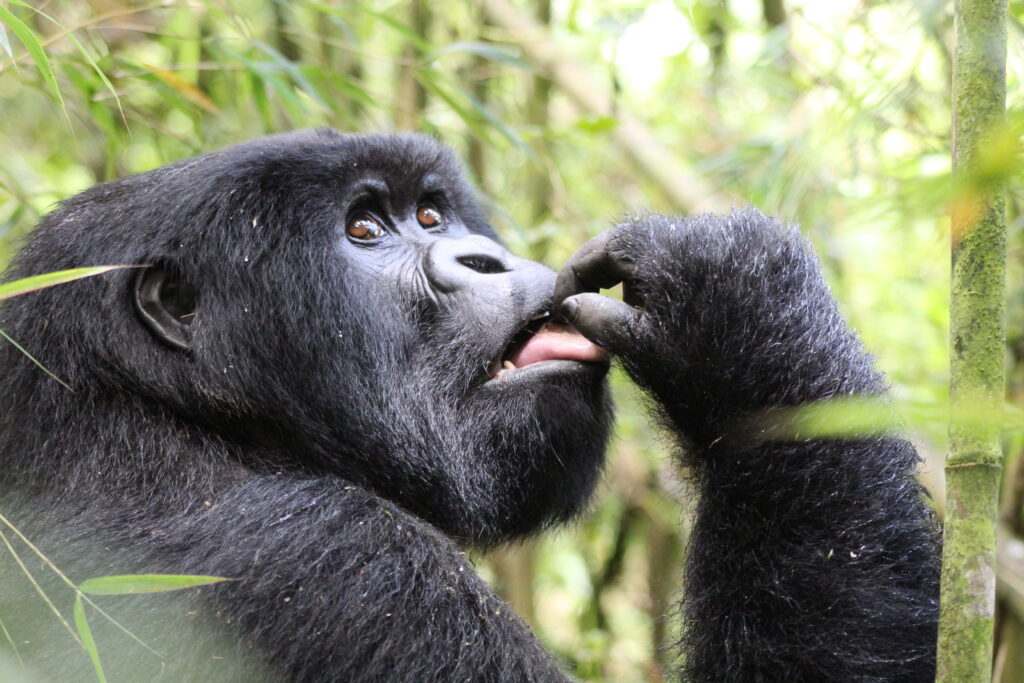
what is gorilla trekking ?
Gorilla trekking is a guided journey through natural forest to locate and observe a habituated family of wild gorillas. In Uganda, experienced park rangers and trackers lead visitors through mountain forests where gorilla families are monitored as part of long-term conservation programmes.
The word "habituated" is particularly important when understanding how gorilla tourism works. A habituated gorilla is not a tame gorilla. It remains a completely wild animal. Habituation is instead a gradual process during which researchers, trackers and conservation teams carefully introduce a gorilla family to the presence of people. Over time, the animals learn that these controlled groups of humans do not represent a threat.
This process allows small groups of visitors to observe certain gorilla families without producing the level of alarm that could result if unhabituated wild gorillas suddenly encountered humans.
The trek normally begins early in the morning at the relevant park headquarters. Visitors are registered and briefed before being divided into groups and assigned a particular gorilla family. Trackers often have some knowledge of where that family was observed previously, but gorillas are constantly moving through the forest in search of food and suitable resting areas.
This means no two gorilla treks are exactly the same.
Some guests may walk for a relatively short period before locating their gorilla family. Others may spend several hours climbing through steep forest terrain. Rain, vegetation, altitude and the movement of the gorillas can all influence the difficulty of the day.
Once the gorillas are located, however, the trek changes into an observation experience. Guests normally spend a limited period with the gorilla family while following strict instructions from the rangers. During this time you may watch gorillas feeding, resting, grooming, playing or moving through the vegetation.
The experience can feel surprisingly intimate. Gorillas communicate through body language, vocalisations and subtle social interactions. Young gorillas behave with an energy that can seem almost childlike, while the enormous silverback may appear remarkably calm.
It is this combination of wilderness, uncertainty and familiarity that makes gorilla trekking unlike almost any other safari activity.
where can you go to track gorillas ?
Mountain gorilla trekking in Uganda takes place in Bwindi Impenetrable National Park and Mgahinga Gorilla National Park. Both parks lie in south-western Uganda, but they offer very different landscapes and experiences.
Bwindi is an ancient mountain rainforest of steep valleys, ridges, streams and dense vegetation. It is Uganda's principal gorilla trekking destination and contains several separate trekking areas. The forest is incredibly atmospheric, particularly in the early morning when mist can hang between the hills and clouds drift across the canopy.
Mgahinga, by contrast, lies within the Virunga Mountains. Here the landscape is dominated by massive extinct volcanoes rising above bamboo forests and montane vegetation. The park is considerably smaller than Bwindi but offers some of Uganda's most spectacular mountain scenery.
Most first-time guests choose Bwindi because it has more trekking regions, more accommodation and greater flexibility when designing itineraries. However, Mgahinga should not be considered an inferior alternative. For some travellers, particularly those interested in volcano hiking, golden monkeys and the wider Virunga ecosystem, Mgahinga can actually be the better choice.
gorilla trekking in bwindi impenetrable national park
Bwindi Impenetrable National Park is the heart of gorilla trekking tourism in Uganda. Located in the south-western highlands, the forest protects an extraordinary ecosystem that has survived for thousands of years.
The landscape itself contributes greatly to the experience. Bwindi is not a flat tropical forest. It rises and falls dramatically across mountain slopes and deeply cut valleys. Dense vegetation covers almost every available surface, while streams descend through the forest and disappear beneath enormous tree ferns and tangled vines.
This geography explains why travellers should understand the structure of Bwindi before making accommodation reservations.
Bwindi is divided into four main gorilla trekking sectors: Buhoma, Ruhija, Rushaga and Nkuringo. Each has its own trekking headquarters and nearby accommodation. Although all four are technically within Bwindi, travelling between them can take considerable time because mountain roads follow ridges and valleys rather than straight lines.
One of the most common planning errors is booking a beautiful lodge without first confirming which trekking sector the gorilla permit belongs to. A lodge described online as being "in Bwindi" may be several hours away from your actual trekking headquarters.
For this reason, checking in with us for gorilla permit availability should normally be considered before accommodation is finalised.
gorilla trekking in buhoma
Buhoma lies in the northern part of Bwindi and is one of Uganda's most famous gorilla trekking areas. It was among the earliest parts of the forest to develop organised gorilla tourism and has consequently developed a broad range of accommodation.
The landscape around Buhoma feels distinctly tropical. Forest-covered slopes rise above the village while lodges and camps sit close to the park boundary. On cool mornings, clouds and mist can settle over the hills before lifting as the day warms.
One of Buhoma's greatest logistical advantages is its relationship with Queen Elizabeth National Park, particularly the Ishasha sector. Travellers combining a traditional wildlife safari with gorilla trekking can often travel from Queen Elizabeth toward Buhoma, creating a natural transition from open savannah to rainforest.
This makes Buhoma particularly attractive for travellers who want to see lions, elephants, buffaloes and other large mammals before continuing to mountain gorillas.
The region also offers opportunities for forest walks, birdwatching and community experiences when time permits.
However, travellers should never assume that trekking in Buhoma will necessarily be easier than trekking elsewhere. Gorilla families move continuously and the difficulty of the trek depends significantly on where the assigned family is located on that particular day.
A family that spent the previous evening near the edge of the forest could move much farther into the hills by morning. Accommodation is key but should be considered after securing a permit. Our preferred choice in this region is Gorilla Forest Lodge.
gorilla trekking in ruhija
Ruhija lies on the eastern side of Bwindi and offers a somewhat different atmosphere. The landscape is high, cool and mountainous, with magnificent views across forested ridges.
It is particularly attractive to travellers with an interest in birds. Bwindi is one of Africa's most significant birding destinations and the forests around Ruhija are especially important for several Albertine Rift species.
The higher altitude can make mornings noticeably cool, so travellers should be prepared for changing temperatures. Once trekking begins, however, climbing through the forest quickly produces enough warmth.
Ruhija can work very well within certain Uganda itineraries, particularly when the route approaches Bwindi from the east. As everywhere in the park, accommodation should be selected according to the trekking permit rather than simply by looking at a map.Our best choice here is Kiho Gorilla Safari Lodge.
The roads around Bwindi frequently appear shorter on maps than they feel in practice. Mountain terrain, weather and road conditions all affect journey times.
This is why local route knowledge becomes particularly important when designing a gorilla safari.
gorilla trekking in rushaga
Rushaga is one of the principal trekking areas in southern Bwindi. The surrounding countryside is among the most beautiful in Uganda, with steep cultivated hills descending into valleys before rising again toward the dark edge of the forest.
The southern position of Rushaga makes it particularly useful for travellers approaching Kisoro or combining the gorilla experience with Lake Bunyonyi, Mgahinga Gorilla National Park or Rwanda.
Rushaga is also strongly associated with Uganda's Gorilla Habituation Experience. This makes it especially interesting for serious photographers, primate enthusiasts and travellers who want more time observing gorillas than is permitted during a conventional trek.
Accommodation in southern Bwindi has expanded considerably and travellers can now choose from relatively simple lodges through to sophisticated luxury properties.Our preferred lodge being Gorilla Treetops Lodge.
The scenery also makes Rushaga attractive even beyond the gorilla experience. Roads wind through terraced hills and small communities, while the volcanic mountains toward Kisoro may sometimes be visible in the distance.
gorilla trekking in nkuringo
Nkuringo lies in southern Bwindi and is famous for its dramatic mountain scenery. The region sits high above deep valleys, with extensive views across cultivated hills and, under favourable conditions, toward the Virunga volcanoes.
The terrain around Nkuringo can be challenging. Steep slopes are part of the landscape and travellers should be comfortable with hill walking. However, as with every sector, the actual difficulty of the gorilla trek depends on where the gorillas happen to be.
Some treks may be demanding while others prove surprisingly manageable.
Nkuringo is particularly attractive to adventurous travellers who value scenery almost as much as wildlife. The surrounding countryside is beautiful enough that simply driving through the region can become one of the highlights of a Uganda safari. For accommodation, we prefer our guests staying at Clouds Mountain Gorilla Lodge.
It also combines naturally with Kisoro, Rushaga, Lake Mutanda, Lake Bunyonyi and Mgahinga.
what bwindi gorilla trekking sector is best ?
There is no single Bwindi trekking sector that can objectively be described as the best. The correct choice depends on the guest.
Permit availability is one of the first considerations. Gorilla permits are limited, so preferred dates may determine which sectors remain available.
Your wider itinerary is equally important. When coming from Queen Elizabeth National Park, our guests may be better suited to a different sector from someone arriving through Kisoro. A guest flying into the region may also require a different approach from someone travelling entirely by road.
Accommodation preferences matter as well. Some sectors have a larger variety of properties, while particular luxury lodges may naturally work with specific trekking headquarters.
Fitness can also play a role, although nobody can guarantee an easy trek simply by selecting one sector over another.
At Buutu Safaris, we generally recommend choosing a sector by looking at the entire safari rather than treating the gorilla trek as an isolated activity. The days immediately before and after Bwindi matter. A well-designed route can eliminate unnecessary driving and create a much more relaxed safari.
gorilla trekking in mgahinga national park
Mgahinga Gorilla National Park is smaller and less famous than Bwindi, but it offers one of Uganda's most visually spectacular gorilla experiences.
The park forms part of the Virunga mountain ecosystem and is dominated by three enormous volcanoes: Mount Muhabura, Mount Gahinga and Mount Sabyinyo.
These mountains give Mgahinga a very different character from Bwindi. Instead of endless ridges covered by ancient rainforest, the landscape feels volcanic and expansive. Bamboo forests climb the mountain slopes while clouds frequently gather around the summits.
Mountain gorillas move within this ecosystem, while the park is also famous for golden monkeys.
For travellers who enjoy active adventures, Mgahinga can be incorporated into an itinerary that includes gorilla trekking, golden monkey tracking and volcano hiking.
Its proximity to Kisoro also makes it convenient for certain Rwanda and southern Uganda itineraries.
For many years, Mgahinga was overlooked by travellers automatically choosing Bwindi. That is unfortunate because the park offers an exceptional wilderness experience in its own right.
bwindi or mgahinga? which is the best for gorilla trekking?
Bwindi is usually the better option for travellers seeking the greatest flexibility. It has several trekking sectors, a larger selection of lodges and more established combinations with other Uganda safari destinations.
Mgahinga may appeal more strongly to travellers fascinated by mountain landscapes and the Virunga volcanoes. It is also attractive for those who want to combine mountain gorillas with golden monkeys or serious hiking.
Neither park should be regarded as a second-rate substitute for the other.
The best choice depends on the itinerary.
For some travellers, the ancient rainforest atmosphere of Bwindi creates exactly the experience they imagined. For others, walking beneath the enormous volcanoes of Mgahinga becomes the more memorable setting.
The cost of gorilla trekking in Uganda includes much more than the gorilla permit. The permit is the most important fixed cost, but our guests also need to consider accommodation, transportation, meals, guiding, park activities and, where applicable, domestic flights.
Gorilla permit rates are controlled by the Uganda Wildlife Authority and can change over time. Rates can also differ according to residency categories and specific promotional periods.
For this reason, guests should always confirm the permit price that applies to their actual trekking date with us rather than relying on an old article found through Google.
The final cost of a gorilla safari depends heavily on travel style. A short overland trip using comfortable midrange lodges will cost considerably less than a luxury fly-in safari with premium accommodation.
However, the permit itself remains essentially the same conservation experience regardless of whether you sleep in a simple lodge or a high-end forest property.
This makes gorilla trekking unusual within luxury travel. Paying more for accommodation can transform comfort and service, but it does not purchase a "better" gorilla family or a longer standard encounter.
Everyone entering the forest is subject to the same conservation rules.
what does a uganda gorilla permit include?
A Uganda gorilla permit authorises one person to participate in the designated gorilla trekking experience on a particular date.
The permit covers access to the regulated trekking activity and the park personnel involved in guiding and managing the encounter.
It does not generally include your safari vehicle, accommodation, meals outside the park activity or the rest of your Uganda itinerary.
This distinction is important when comparing gorilla safari prices online.
Some advertised prices include permits while others exclude them. Some include private transportation while others are based on scheduled group departures. Luxury properties may quote accommodation separately from park fees.
Travellers should therefore compare the complete cost of the safari rather than simply selecting the lowest headline figure.
At Buutu Safaris, we prefer to explain clearly what is and is not included before a guest commits to a programme.
how do you book a gorilla permit in uganda?
For most international travellers, the easiest way to organise gorilla permits is as part of the complete safari planning process.
The permit should normally be considered early because it determines where you need to be on the morning of the trek.
Once approximate travel dates are known, permit availability can be checked. The available sector can then be matched with appropriate accommodation and transportation.
This order is important.
Guests sometimes book flights and hotels first and only later begin searching for gorilla permits. If the preferred trekking date or sector is no longer available, substantial changes may then be required.
Another common error is reserving accommodation before establishing which trekking sector will be used.
The safer sequence is to establish travel dates, check suitable gorilla availability, secure the permit and then finalise the lodge and surrounding safari route.
how far in advance should you book gorilla trekking?
The earlier you can book, the greater your flexibility.
This is particularly important for peak travel periods, Christmas and New Year holidays, larger groups and guests requiring particular luxury lodges.
It also matters when combining Uganda with Kenya or Tanzania because international and regional flight schedules create additional constraints.
Gorilla tourism is intentionally controlled. Visitor numbers cannot simply be increased whenever demand rises because the purpose of the permit system is partly to limit pressure on the gorillas.
For this reason, popular dates can become unavailable.
Planning ahead gives you more choice over trekking sector, accommodation and safari routing.
That said, last-minute gorilla safaris can sometimes be arranged when permits remain available. Travellers with flexible dates may be able to take advantage of cancellations or remaining availability.
The important point is not to assume. Check before making other non-refundable arrangements.