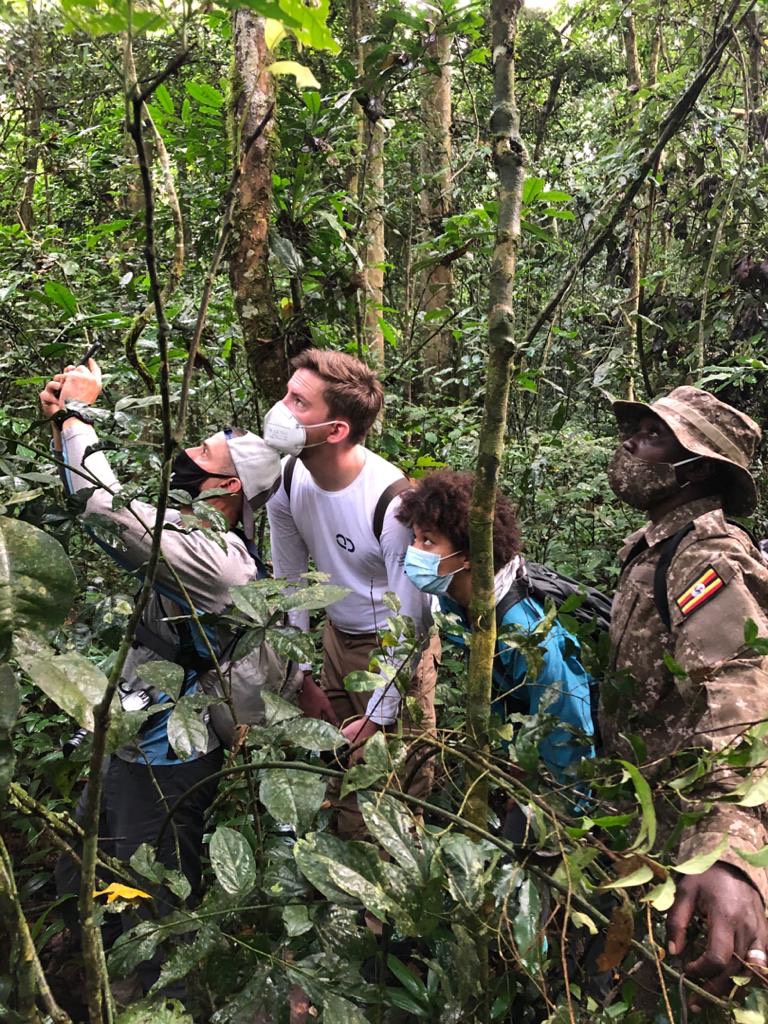
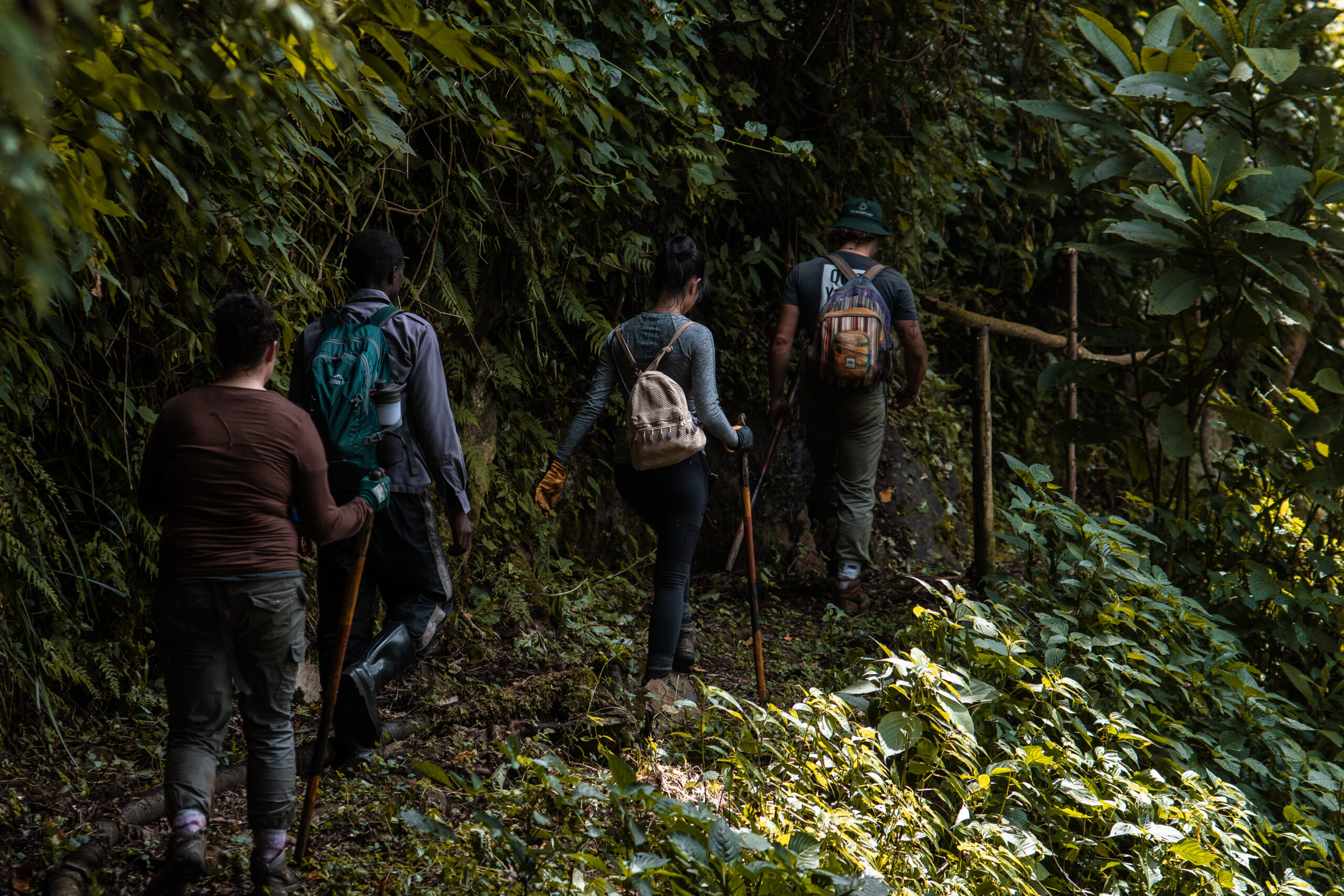
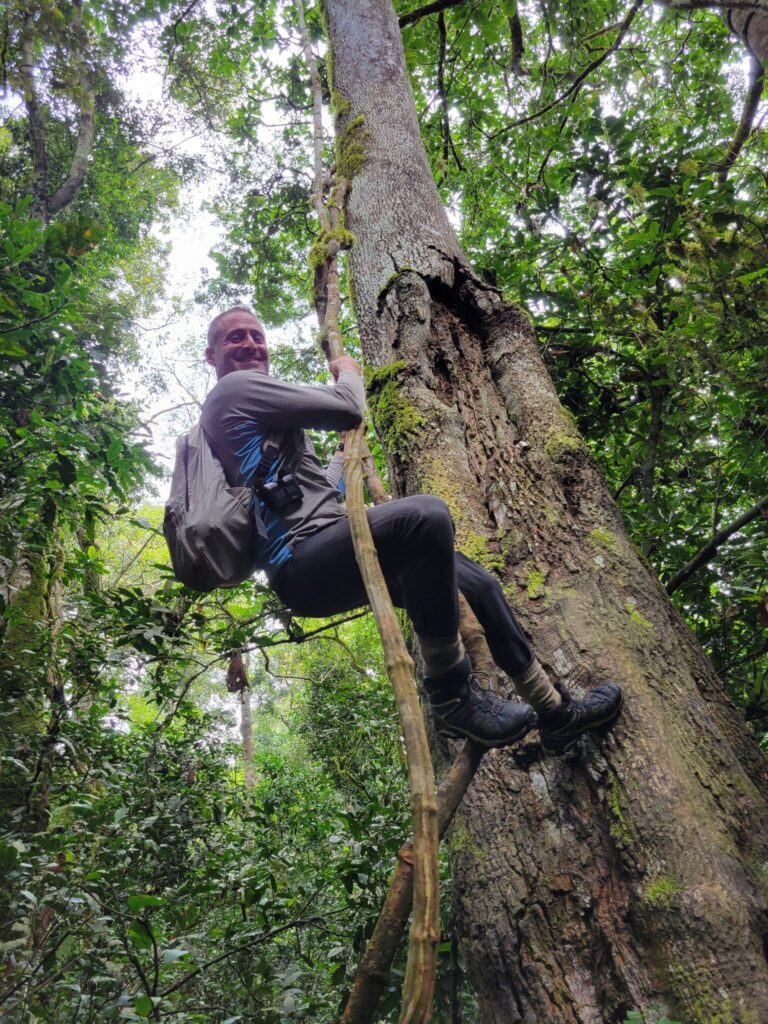
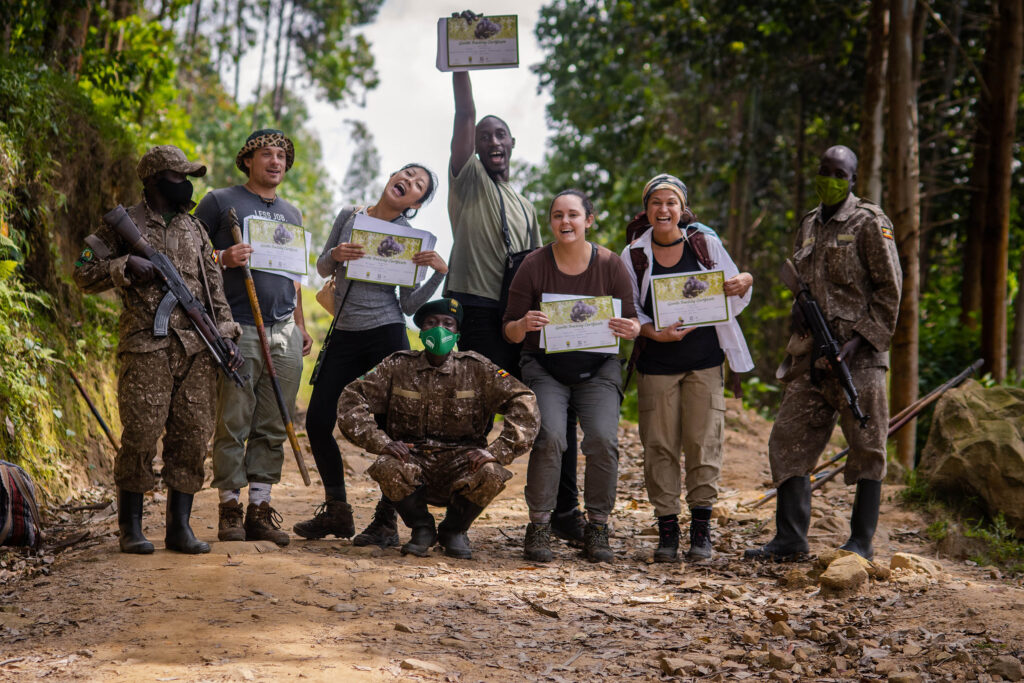
Gorilla trekking in Uganda is one of the most extraordinary wildlife experiences available anywhere in Africa. It is very different from a traditional safari, where wildlife is normally observed from the comfort of a vehicle. To see mountain gorillas, you have to enter their world on foot. You walk through tropical rainforest, follow paths across steep mountain slopes, cross streams and push through thick vegetation with experienced trackers until, somewhere deep inside the forest, you encounter a family of wild mountain gorillas.
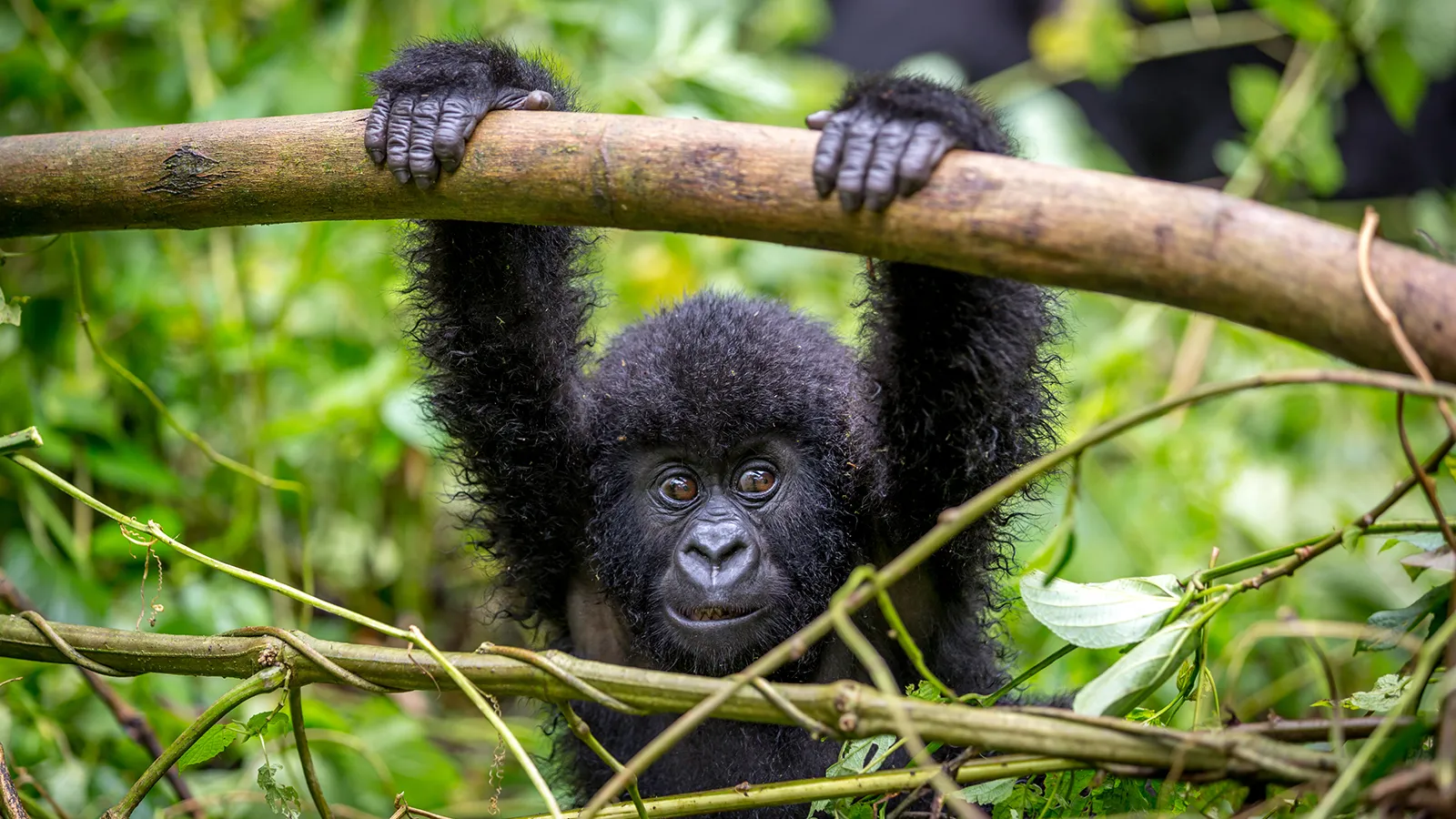
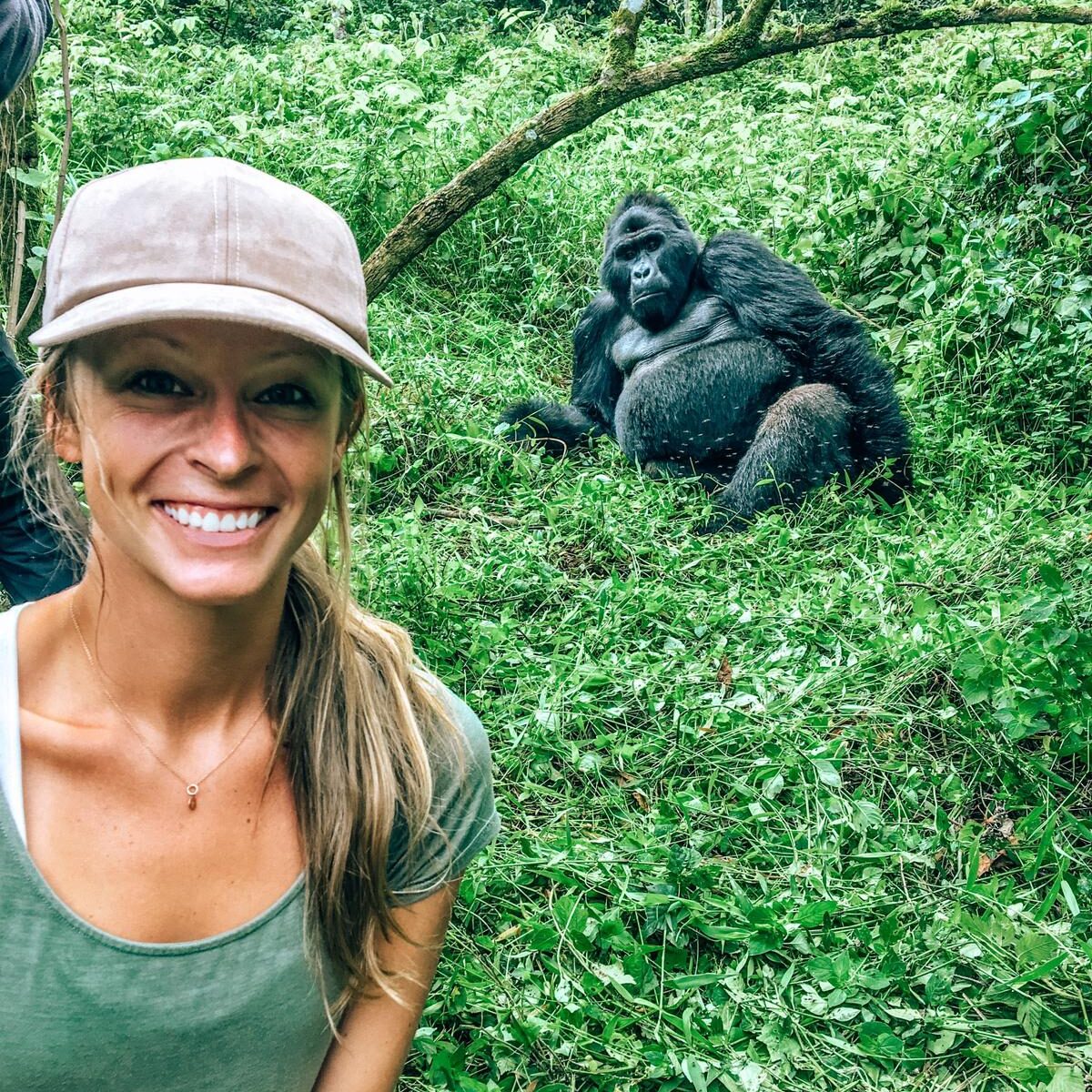
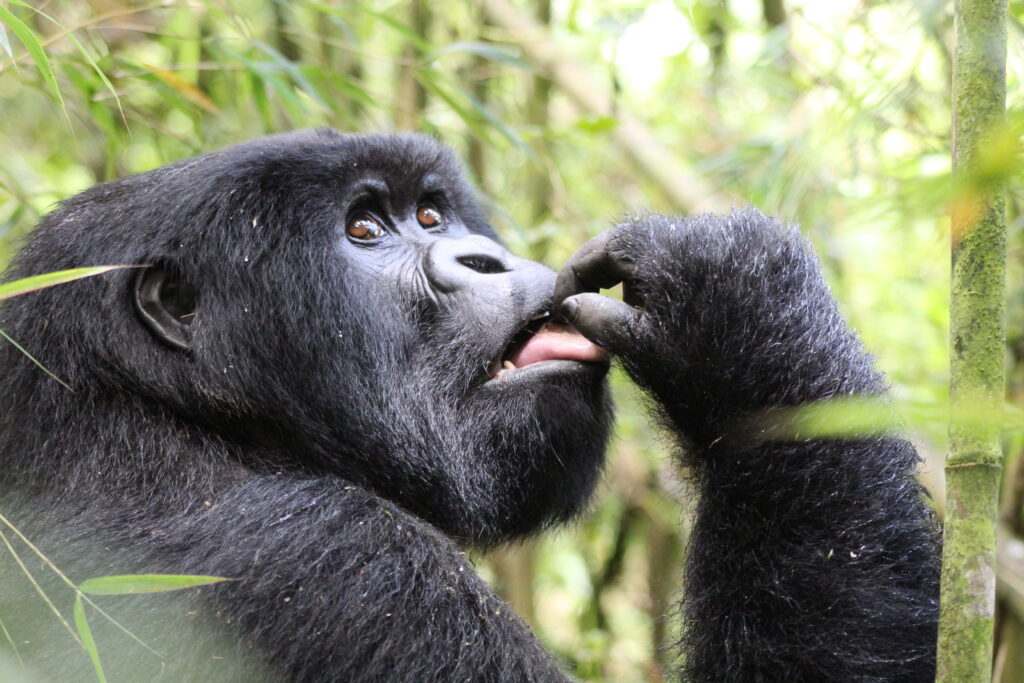
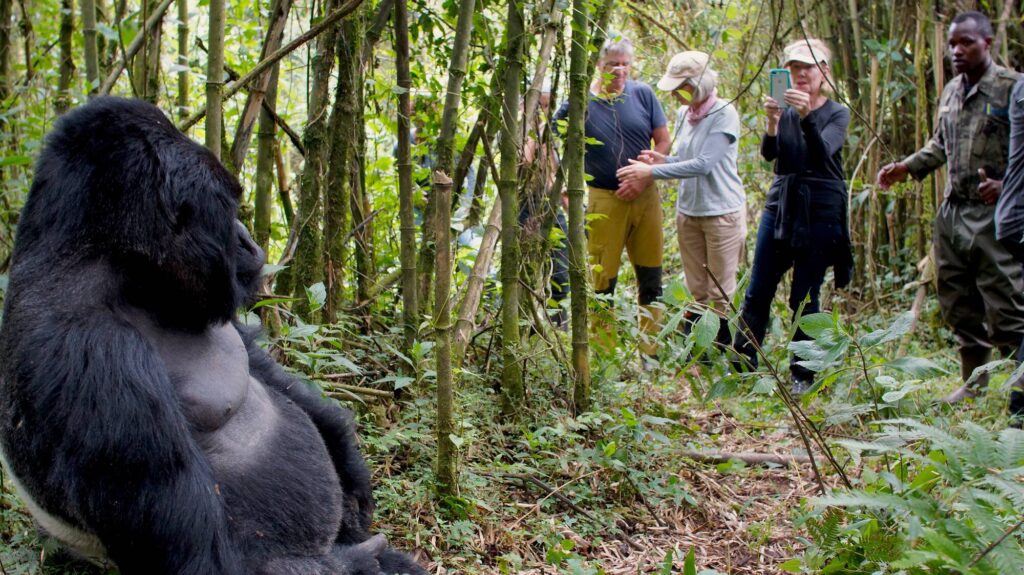
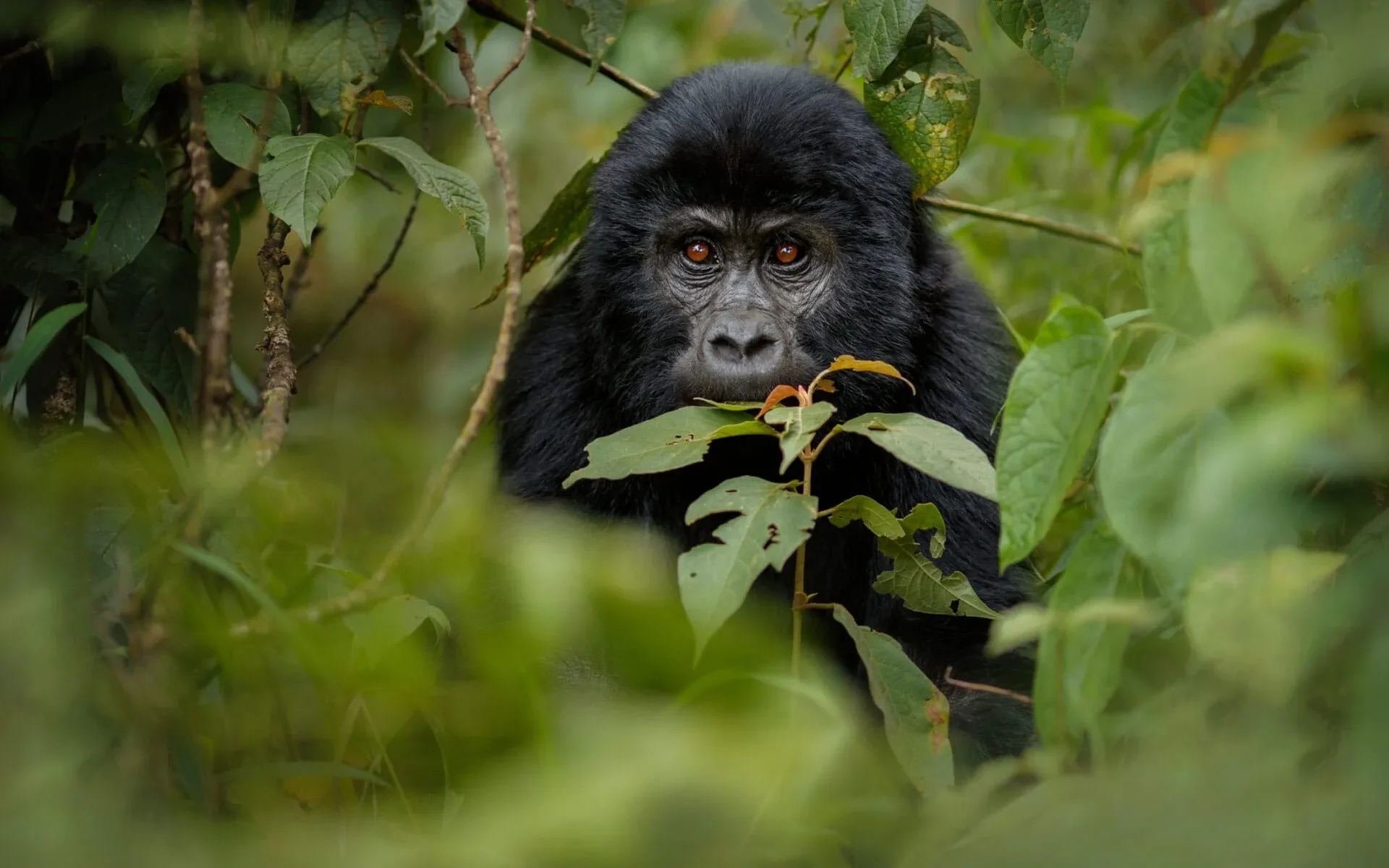
There is usually a remarkable change in atmosphere when the gorillas are finally located. The conversation stops, cameras are prepared and the group follows the ranger quietly through the vegetation. Sometimes the first gorilla you notice is a young animal climbing through the branches. On another trek it might be an enormous silverback sitting quietly on the forest floor, pulling vegetation toward himself and eating with almost complete indifference to the humans watching nearby. A mother may carry an infant against her body while juveniles wrestle, climb trees or chase each other through the undergrowth.
Nothing is staged. The gorillas are not captive animals and they are not trained to perform for visitors. They move freely through the forest, choosing where they feed, rest and travel. This is what makes gorilla trekking so powerful. For a short period, humans are allowed to enter the natural environment of one of our closest relatives and observe their lives at remarkably close range.
Uganda is one of the world’s most important destinations for mountain gorilla trekking. The experience takes place in two protected areas in the south-west of the country: Bwindi Impenetrable National Park and Mgahinga Gorilla National Park. Bwindi is the better known of the two and contains several different gorilla trekking regions, while Mgahinga forms part of the dramatic Virunga volcanic landscape shared by Uganda, Rwanda and the Democratic Republic of Congo.
Planning a gorilla safari, however, involves much more than simply deciding to visit Bwindi. Our guests need to understand gorilla permits, trekking sectors, weather, accommodation, fitness, transportation and the amount of time required. They also need to decide whether they want to combine gorillas with chimpanzees, traditional game viewing, Rwanda, Kenya or Tanzania.
This comprehensive Uganda gorilla trekking guide has been created to answer those questions and help travellers understand exactly what to expect before they arrive.
At Buutu Safaris, we believe that a successful gorilla safari begins long before you enter the forest. The right gorilla permit needs to be matched with the right trekking region, the right accommodation and a realistic safari route. When those pieces are planned properly, the gorilla trek becomes the highlight of a much larger journey through one of Africa’s most diverse wildlife destinations.
What is Gorilla Trekking?
Gorilla trekking is a guided journey through natural forest to locate and observe a habituated family of wild gorillas. In Uganda, experienced park rangers and trackers lead visitors through mountain forests where gorilla families are monitored as part of long-term conservation programmes.
The word “habituated” is particularly important when understanding how gorilla tourism works. A habituated gorilla is not a tame gorilla. It remains a completely wild animal. Habituation is instead a gradual process during which researchers, trackers and conservation teams carefully introduce a gorilla family to the presence of people. Over time, the animals learn that these controlled groups of humans do not represent a threat.
This process allows small groups of visitors to observe certain gorilla families without producing the level of alarm that could result if unhabituated wild gorillas suddenly encountered humans.
The trek normally begins early in the morning at the relevant park headquarters. Visitors are registered and briefed before being divided into groups and assigned a particular gorilla family. Trackers often have some knowledge of where that family was observed previously, but gorillas are constantly moving through the forest in search of food and suitable resting areas.
This means no two gorilla treks are exactly the same.
Some guests may walk for a relatively short period before locating their gorilla family. Others may spend several hours climbing through steep forest terrain. Rain, vegetation, altitude and the movement of the gorillas can all influence the difficulty of the day.
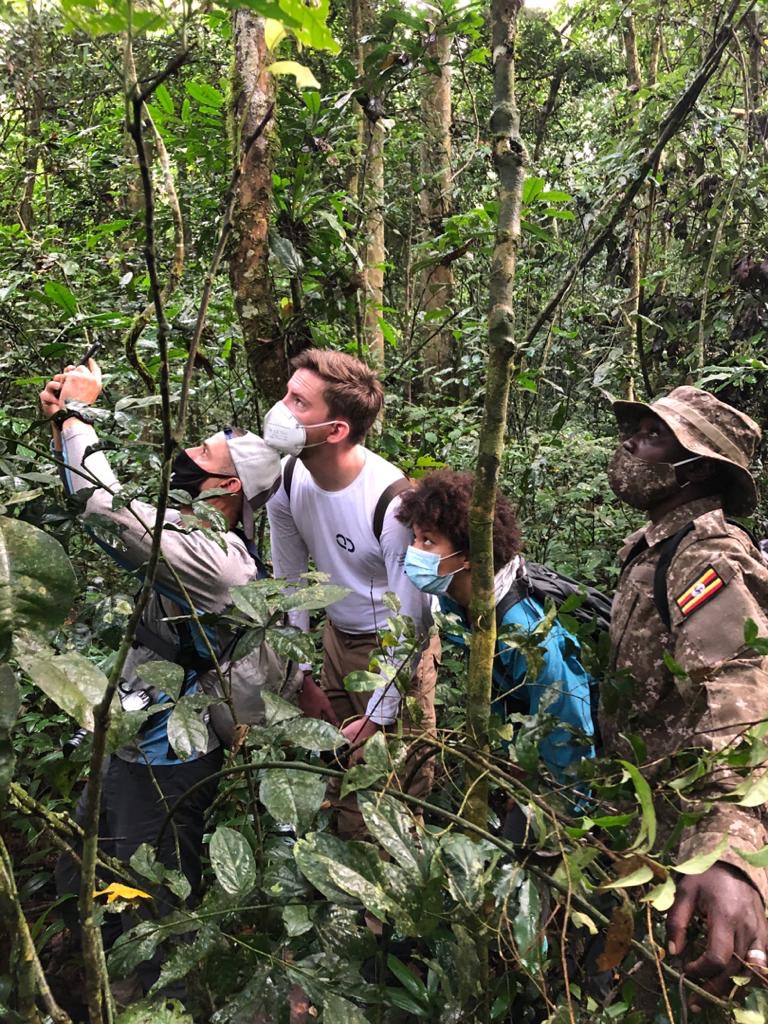
Once the gorillas are located, however, the trek changes into an observation experience. Guests normally spend a limited period with the gorilla family while following strict instructions from the rangers. During this time you may watch gorillas feeding, resting, grooming, playing or moving through the vegetation.
The experience can feel surprisingly intimate. Gorillas communicate through body language, vocalisations and subtle social interactions. Young gorillas behave with an energy that can seem almost childlike, while the enormous silverback may appear remarkably calm.
It is this combination of wilderness, uncertainty and familiarity that makes gorilla trekking unlike almost any other safari activity.
Where can you Go Gorilla Trekking in Uganda?
Mountain gorilla trekking in Uganda takes place in Bwindi Impenetrable National Park and Mgahinga Gorilla National Park. Both parks lie in south-western Uganda, but they offer very different landscapes and experiences.
Bwindi is an ancient mountain rainforest of steep valleys, ridges, streams and dense vegetation. It is Uganda’s principal gorilla trekking destination and contains several separate trekking areas. The forest is incredibly atmospheric, particularly in the early morning when mist can hang between the hills and clouds drift across the canopy.
Mgahinga, by contrast, lies within the Virunga Mountains. Here the landscape is dominated by massive extinct volcanoes rising above bamboo forests and montane vegetation. The park is considerably smaller than Bwindi but offers some of Uganda’s most spectacular mountain scenery.
Most first-time guests choose Bwindi because it has more trekking regions, more accommodation and greater flexibility when designing itineraries. However, Mgahinga should not be considered an inferior alternative. For some travellers, particularly those interested in volcano hiking, golden monkeys and the wider Virunga ecosystem, Mgahinga can actually be the better choice.
Gorilla Trekking in Bwindi Impenetrable National Park
Bwindi Impenetrable National Park is the heart of gorilla trekking tourism in Uganda. Located in the south-western highlands, the forest protects an extraordinary ecosystem that has survived for thousands of years.
The landscape itself contributes greatly to the experience. Bwindi is not a flat tropical forest. It rises and falls dramatically across mountain slopes and deeply cut valleys. Dense vegetation covers almost every available surface, while streams descend through the forest and disappear beneath enormous tree ferns and tangled vines.
This geography explains why travellers should understand the structure of Bwindi before making accommodation reservations.
Bwindi is divided into four main gorilla trekking sectors: Buhoma, Ruhija, Rushaga and Nkuringo. Each has its own trekking headquarters and nearby accommodation. Although all four are technically within Bwindi, travelling between them can take considerable time because mountain roads follow ridges and valleys rather than straight lines.
One of the most common planning errors is booking a beautiful lodge without first confirming which trekking sector the gorilla permit belongs to. A lodge described online as being “in Bwindi” may be several hours away from your actual trekking headquarters.
For this reason, checking in with us for gorilla permit availability should normally be considered before accommodation is finalised.
Gorilla Trekking in Buhoma
Buhoma lies in the northern part of Bwindi and is one of Uganda’s most famous gorilla trekking areas. It was among the earliest parts of the forest to develop organised gorilla tourism and has consequently developed a broad range of accommodation.
The landscape around Buhoma feels distinctly tropical. Forest-covered slopes rise above the village while lodges and camps sit close to the park boundary. On cool mornings, clouds and mist can settle over the hills before lifting as the day warms.
One of Buhoma’s greatest logistical advantages is its relationship with Queen Elizabeth National Park, particularly the Ishasha sector. Travellers combining a traditional wildlife safari with gorilla trekking can often travel from Queen Elizabeth toward Buhoma, creating a natural transition from open savannah to rainforest.
This makes Buhoma particularly attractive for travellers who want to see lions, elephants, buffaloes and other large mammals before continuing to mountain gorillas.
The region also offers opportunities for forest walks, birdwatching and community experiences when time permits.
However, travellers should never assume that trekking in Buhoma will necessarily be easier than trekking elsewhere. Gorilla families move continuously and the difficulty of the trek depends significantly on where the assigned family is located on that particular day.
A family that spent the previous evening near the edge of the forest could move much farther into the hills by morning. Accommodation is key but should be considered after securing a permit. Our preferred choice in this region is Gorilla Forest Lodge.
Gorilla Trekking in Ruhija
Ruhija lies on the eastern side of Bwindi and offers a somewhat different atmosphere. The landscape is high, cool and mountainous, with magnificent views across forested ridges.
It is particularly attractive to travellers with an interest in birds. Bwindi is one of Africa’s most significant birding destinations and the forests around Ruhija are especially important for several Albertine Rift species.
The higher altitude can make mornings noticeably cool, so travellers should be prepared for changing temperatures. Once trekking begins, however, climbing through the forest quickly produces enough warmth.
Ruhija can work very well within certain Uganda itineraries, particularly when the route approaches Bwindi from the east. As everywhere in the park, accommodation should be selected according to the trekking permit rather than simply by looking at a map.Our best choice here is Kiho Gorilla Safari Lodge.
The roads around Bwindi frequently appear shorter on maps than they feel in practice. Mountain terrain, weather and road conditions all affect journey times.
This is why local route knowledge becomes particularly important when designing a gorilla safari.
Gorilla Trekking in Rushaga
Rushaga is one of the principal trekking areas in southern Bwindi. The surrounding countryside is among the most beautiful in Uganda, with steep cultivated hills descending into valleys before rising again toward the dark edge of the forest.
The southern position of Rushaga makes it particularly useful for travellers approaching Kisoro or combining the gorilla experience with Lake Bunyonyi, Mgahinga Gorilla National Park or Rwanda.
Rushaga is also strongly associated with Uganda’s Gorilla Habituation Experience. This makes it especially interesting for serious photographers, primate enthusiasts and travellers who want more time observing gorillas than is permitted during a conventional trek.
Accommodation in southern Bwindi has expanded considerably and travellers can now choose from relatively simple lodges through to sophisticated luxury properties.Our preferred lodge being Gorilla Treetops Lodge.
The scenery also makes Rushaga attractive even beyond the gorilla experience. Roads wind through terraced hills and small communities, while the volcanic mountains toward Kisoro may sometimes be visible in the distance.
Gorilla Trekking in Nkuringo
Nkuringo lies in southern Bwindi and is famous for its dramatic mountain scenery. The region sits high above deep valleys, with extensive views across cultivated hills and, under favourable conditions, toward the Virunga volcanoes.
The terrain around Nkuringo can be challenging. Steep slopes are part of the landscape and travellers should be comfortable with hill walking. However, as with every sector, the actual difficulty of the gorilla trek depends on where the gorillas happen to be.
Some treks may be demanding while others prove surprisingly manageable.
Nkuringo is particularly attractive to adventurous travellers who value scenery almost as much as wildlife. The surrounding countryside is beautiful enough that simply driving through the region can become one of the highlights of a Uganda safari. For accommodation, we prefer our guests staying at Clouds Mountain Gorilla Lodge.
It also combines naturally with Kisoro, Rushaga, Lake Mutanda, Lake Bunyonyi and Mgahinga.
Which Bwindi Gorilla Trekking Sector is Best?
There is no single Bwindi trekking sector that can objectively be described as the best. The correct choice depends on the guest.
Permit availability is one of the first considerations. Gorilla permits are limited, so preferred dates may determine which sectors remain available.
Your wider itinerary is equally important. When coming from Queen Elizabeth National Park, our guests may be better suited to a different sector from someone arriving through Kisoro. A guest flying into the region may also require a different approach from someone travelling entirely by road.
Accommodation preferences matter as well. Some sectors have a larger variety of properties, while particular luxury lodges may naturally work with specific trekking headquarters.
Fitness can also play a role, although nobody can guarantee an easy trek simply by selecting one sector over another.
At Buutu Safaris, we generally recommend choosing a sector by looking at the entire safari rather than treating the gorilla trek as an isolated activity. The days immediately before and after Bwindi matter. A well-designed route can eliminate unnecessary driving and create a much more relaxed safari.
Gorilla Trekking in Mgahinga Gorilla National Park
Mgahinga Gorilla National Park is smaller and less famous than Bwindi, but it offers one of Uganda’s most visually spectacular gorilla experiences.
The park forms part of the Virunga mountain ecosystem and is dominated by three enormous volcanoes: Mount Muhabura, Mount Gahinga and Mount Sabyinyo.
These mountains give Mgahinga a very different character from Bwindi. Instead of endless ridges covered by ancient rainforest, the landscape feels volcanic and expansive. Bamboo forests climb the mountain slopes while clouds frequently gather around the summits.
Mountain gorillas move within this ecosystem, while the park is also famous for golden monkeys.
For travellers who enjoy active adventures, Mgahinga can be incorporated into an itinerary that includes gorilla trekking, golden monkey tracking and volcano hiking.
Its proximity to Kisoro also makes it convenient for certain Rwanda and southern Uganda itineraries.
For many years, Mgahinga was overlooked by travellers automatically choosing Bwindi. That is unfortunate because the park offers an exceptional wilderness experience in its own right.
Bwindi or Mgahinga: Which is better for Gorilla Trekking
Bwindi is usually the better option for travellers seeking the greatest flexibility. It has several trekking sectors, a larger selection of lodges and more established combinations with other Uganda safari destinations.
Mgahinga may appeal more strongly to travellers fascinated by mountain landscapes and the Virunga volcanoes. It is also attractive for those who want to combine mountain gorillas with golden monkeys or serious hiking.
Neither park should be regarded as a second-rate substitute for the other.
The best choice depends on the itinerary.
How Much Does Gorilla Trekking in Uganda Cost?
For some travellers, the ancient rainforest atmosphere of Bwindi creates exactly the experience they imagined. For others, walking beneath the enormous volcanoes of Mgahinga becomes the more memorable setting.
The cost of gorilla trekking in Uganda includes much more than the gorilla permit. The permit is the most important fixed cost, but our guests also need to consider accommodation, transportation, meals, guiding, park activities and, where applicable, domestic flights.
Gorilla permit rates are controlled by the Uganda Wildlife Authority and can change over time. Rates can also differ according to residency categories and specific promotional periods.
For this reason, guests should always confirm the permit price that applies to their actual trekking date with us rather than relying on an old article found through Google.
The final cost of a gorilla safari depends heavily on travel style. A short overland trip using comfortable midrange lodges will cost considerably less than a luxury fly-in safari with premium accommodation.
However, the permit itself remains essentially the same conservation experience regardless of whether you sleep in a simple lodge or a high-end forest property.
This makes gorilla trekking unusual within luxury travel. Paying more for accommodation can transform comfort and service, but it does not purchase a “better” gorilla family or a longer standard encounter.
What Does a Uganda Gorilla Permit Include?
Everyone entering the forest is subject to the same conservation rules.
A Uganda gorilla permit authorises one person to participate in the designated gorilla trekking experience on a particular date.
The permit covers access to the regulated trekking activity and the park personnel involved in guiding and managing the encounter.
It does not generally include your safari vehicle, accommodation, meals outside the park activity or the rest of your Uganda itinerary.
This distinction is important when comparing gorilla safari prices online.
Some advertised prices include permits while others exclude them. Some include private transportation while others are based on scheduled group departures. Luxury properties may quote accommodation separately from park fees.
Travellers should therefore compare the complete cost of the safari rather than simply selecting the lowest headline figure.
At Buutu Safaris, we prefer to explain clearly what is and is not included before a guest commits to a programme.
How Do You Book a Gorilla Permit in Uganda?
For most international travellers, the easiest way to organise gorilla permits is as part of the complete safari planning process.
The permit should normally be considered early because it determines where you need to be on the morning of the trek.
Once approximate travel dates are known, permit availability can be checked. The available sector can then be matched with appropriate accommodation and transportation.
This order is important.
Guests sometimes book flights and hotels first and only later begin searching for gorilla permits. If the preferred trekking date or sector is no longer available, substantial changes may then be required.
Another common error is reserving accommodation before establishing which trekking sector will be used.
How Far in Advance Should You Book Gorilla Trekking?
The safer sequence is to establish travel dates, check suitable gorilla availability, secure the permit and then finalise the lodge and surrounding safari route.
The earlier you can book, the greater your flexibility.
This is particularly important for peak travel periods, Christmas and New Year holidays, larger groups and guests requiring particular luxury lodges.
It also matters when combining Uganda with Kenya or Tanzania because international and regional flight schedules create additional constraints.
Gorilla tourism is intentionally controlled. Visitor numbers cannot simply be increased whenever demand rises because the purpose of the permit system is partly to limit pressure on the gorillas.
For this reason, popular dates can become unavailable.
Planning ahead gives you more choice over trekking sector, accommodation and safari routing.
That said, last-minute gorilla safaris can sometimes be arranged when permits remain available. Travellers with flexible dates may be able to take advantage of cancellations or remaining availability.
The important point is not to assume. Check before making other non-refundable arrangements.
What Is the Best Time for Gorilla Trekking in Uganda?
Gorilla trekking in Uganda can take place throughout the year. There is therefore no single month in which guests must visit.
However, weather can influence the difficulty of the trek.
Uganda’s gorilla habitat is rainforest, which means rain can occur at virtually any time of year. Even during relatively dry months, a sunny morning can become wet very quickly.
Broadly speaking, periods around June through September and December through February are often relatively drier and therefore popular with travellers.
Drier conditions can make forest paths easier underfoot. Mud is one of the main factors that increases the difficulty of gorilla trekking, particularly on steep slopes.
The wetter periods can produce heavier rain and more slippery trails, but they should not automatically be dismissed.
Rain transforms Bwindi.
Leaves become intensely green, streams fill, clouds drift through the valleys and mist can create spectacular photographic conditions.
There can also be fewer travellers moving around some areas during quieter periods.
The best time therefore depends on what you value most.
If relatively easier trail conditions are the priority, aim for one of the generally drier periods. If lush scenery, photography and quieter travel appeal more strongly, wetter months can be extremely rewarding.
Is June to September a Good Time for Gorilla Trekking?
June through September is one of the most popular times for gorilla trekking and Uganda safaris generally.
The period often provides relatively favourable weather and fits conveniently with summer holidays in Europe and North America.
It also combines extremely well with safaris in Kenya and Tanzania.
A guest might, for example, experience mountain gorillas in Uganda before continuing to the Masai Mara or Serengeti or vice versa.
The disadvantage of travelling during popular months is demand.
Preferred gorilla permits and accommodation can become harder to secure, particularly when guests require a specific sector.
Planning well in advance is therefore advisable.
Is December to February Good for Gorilla Trekking?
December through February can also be an excellent period.
These months tend to fall within another relatively dry part of Uganda’s annual climate cycle, although rain remains possible.
December is particularly popular because of Christmas and New Year holidays, so early reservations are important.
January and February can offer excellent conditions for a larger Uganda safari incorporating gorillas, chimpanzees and conventional game viewing.
Is Gorilla Trekking During the Rainy Season Worth It?
Yes.
The rainy season does not mean it rains continuously every day, and gorilla trekking continues in wet conditions.
The main challenge is the trail.
Steep paths can become slippery, while sections of forest may become muddy. Good hiking boots, gloves and a porter therefore become especially valuable.
Rain can also make the experience more atmospheric.
Bwindi in heavy mist can feel exactly as its name suggests: ancient, mysterious and almost impenetrable.
Photographers may appreciate the saturated vegetation and dramatic forest light.
Guests should therefore think of wet-season trekking as a different experience rather than an inferior one.
What Happens on the Day of a Gorilla Trek?
A gorilla trekking day generally begins early.
Most guests wake before sunrise, have breakfast and prepare their daypacks before travelling to the relevant park headquarters.
The exact transfer time depends on where the lodge is located.
This is another reason staying near the correct trekking sector matters. An unnecessary long drive before the trek adds stress to a day that is already physically demanding.
At park headquarters, visitors register and attend a briefing conducted by the park authorities.
The briefing explains how the trekking experience operates and how visitors should behave around the gorillas.
You are then assigned to a gorilla family and introduced to your ranger guides.
The group begins walking from either the headquarters itself or a nearby trailhead reached by vehicle.
The first part of the journey can sometimes pass through cultivated countryside before entering the forest.
Once beneath the canopy, the environment changes rapidly.
Paths may narrow. Tree roots cross the trail. Streams appear between rocks. Vegetation becomes thicker and the gradient can become steep.
Trackers working ahead of the visitor group help determine where the gorillas have moved.
The signs they follow can include recently eaten vegetation, nests, droppings, footprints and broken branches.
Eventually, communication between the ranger and trackers indicates that the family has been located.
This is usually one of the most exciting moments of the entire trek.
The ranger may ask visitors to prepare cameras, leave unnecessary equipment with porters and move forward quietly.
Then the gorillas appear.
The encounter is rarely what people imagined.
A silverback looks enormous in photographs, but seeing one sitting a few metres away is completely different. His shoulders seem almost impossibly broad and his hands extraordinarily powerful.
Yet he may spend most of the encounter peacefully eating.
Nearby, juveniles may chase each other between trees while females care for infants.
The group observes quietly as the gorillas continue with their normal lives.
When the permitted observation period ends, the ranger begins leading the group away.
The walk back can sometimes feel easier simply because the emotional goal has been achieved.
Eventually the forest begins to thin and the group emerges again into the surrounding landscape.
By this stage, boots may be muddy and clothes stained, but very few guests care.
How Difficult Is Gorilla Trekking in Uganda?
Gorilla trekking can range from reasonably straightforward to physically demanding. The difficulty depends primarily on the location of the gorillas.
Because the animals move freely, nobody can know with certainty how far you will need to walk. A family that was close to the park boundary yesterday may move much farther into the forest overnight.
Terrain is another important factor. Bwindi is mountainous. The trek may involve steep slopes, muddy ground, roots, vines and streams.
Rain can make the same trail considerably more difficult.
Fitness also matters.
A guest accustomed to walking hills will probably find the experience easier than someone who rarely walks beyond short distances on flat ground.
However, you do not need to be an athlete. Thousands of ordinary travellers of different ages and fitness levels successfully complete gorilla treks.
Preparation simply improves your chances of enjoying the journey rather than enduring it.
How Fit Should I Be for Gorilla Trekking?
A reasonable level of walking fitness is helpful.
If possible, begin preparing several weeks before travelling.
Regular walking is one of the simplest forms of training. If hills are available near home, use them. If you live somewhere flat, stairs can provide useful preparation.
Cycling, swimming and other moderate cardiovascular exercise can also improve endurance.
The objective is not to become an endurance athlete. You simply want your body to be comfortable walking for several hours. Leg strength and balance are especially useful because the terrain can be uneven.
Training also improves confidence.
A guest who knows they can comfortably walk several kilometres is much less likely to feel anxious when entering the forest.
Can Older Travellers Go Gorilla Trekking?
Yes.
Many travellers in their sixties, seventies and beyond successfully trek mountain gorillas.
Chronological age by itself is not the main issue. Mobility, balance, general health and walking fitness matter far more.
An active 70-year-old who regularly walks may find the trek considerably easier than a sedentary 40-year-old.
Older travellers should discuss mobility limitations with their safari planner before permits are finalised.
This allows the itinerary to be structured appropriately and gives the local team advance knowledge of any assistance that may be required.
A porter is particularly useful.
Medical concerns should be discussed with an appropriate healthcare professional before travelling.
Can Travellers With Limited Mobility See Gorillas?
In some circumstances, yes, but this requires careful advance planning.
Gorilla trekking remains a genuine wilderness activity. Bwindi cannot be converted into a completely accessible environment because the mountains and forest are part of the experience.
However, forms of additional assistance may sometimes be available locally.
Travellers with knee problems, balance difficulties or other mobility limitations should explain these clearly during safari planning.
The earlier the operator understands the situation, the easier it is to determine what is realistically possible.
The important thing is not to make assumptions in either direction.
Do not automatically conclude that gorilla trekking is impossible because you have limited mobility, but equally do not assume the forest can accommodate every physical limitation without preparation.
What Should You Wear for Gorilla Trekking?
Gorilla trekking clothing should be practical rather than fashionable.
The purpose of your clothing is to protect you from vegetation, insects, rain and mud while remaining comfortable during several hours of physical activity.
Long trousers are preferable to shorts because they protect the legs from branches, thorns and vegetation.
A lightweight long-sleeved shirt provides similar protection for the arms while remaining comfortable in humid conditions.
Good hiking footwear is one of the most important investments.
The soles should provide sufficient grip for muddy slopes and uneven ground. Ankle support can also be extremely useful.
Wear your boots before travelling.
Discovering that new boots create blisters during a gorilla trek is not an experience anybody wants.
A lightweight waterproof jacket should always be carried because rainforest weather can change quickly.
Gloves are another surprisingly useful item.
When climbing steep slopes, the instinct is often to grab a branch or plant for support. Simple gardening gloves can protect your hands while providing additional grip.
Gaiters are also useful for keeping mud, vegetation and insects away from the top of your boots.
Comfort is the priority.
You should be able to walk, climb and occasionally crouch without constantly adjusting your clothes.
What Should You Carry on a Gorilla Trek?
Keep your daypack relatively light.
Carry enough drinking water for the trek and any food provided or recommended by your lodge.
A waterproof jacket should remain accessible rather than buried at the bottom of the bag.
Camera equipment should be protected against rain, particularly if you are carrying expensive lenses.
Spare batteries can be valuable because the combination of photography and video can consume power surprisingly quickly.
Any essential personal medication should remain with you.
Sunscreen and insect repellent can also be useful.
The general principle is simple: carry what you genuinely need but avoid turning your backpack into another challenge.
This is one reason hiring a porter is so useful.
Should I Hire a Porter for Gorilla Trekking?
Yes.
At Buutu Safaris, we strongly recommend hiring a porter even for travellers who consider themselves physically fit.
Many people initially think a porter is necessary only to carry a backpack.
In reality, carrying the bag may be the least important service they provide.
A porter can offer a hand while climbing muddy slopes, help you balance when crossing streams and reduce the energy you expend over several hours.
Experienced porters understand the terrain extremely well.
Having someone steady you through a difficult section can completely change the experience.
Hiring a porter also creates direct economic benefits for people living around the protected area.
The relationship between conservation and neighbouring communities matters enormously.
When tourism provides meaningful employment and income, wildlife becomes economically valuable to the people who live closest to it.
A porter is therefore not simply a convenience.
The arrangement can form part of the wider conservation economy surrounding the forest.
Is Gorilla Trekking Safe?
Gorilla trekking is carefully controlled and visitors are accompanied by trained park personnel.
However, mountain gorillas remain wild animals.
The fact that a gorilla family is habituated does not mean the animals are domesticated.
A silverback is an immensely powerful animal and must always be treated with respect.
The safety of gorilla trekking depends heavily on controlled behaviour.
Visitors are briefed before entering the forest and must follow ranger instructions throughout the encounter.
Do not attempt to move independently simply to obtain a better photograph.
Do not touch a gorilla.
Do not feed one.
Do not deliberately move closer than instructed.
Do not imitate gorilla behaviour because you saw somebody do it on social media.
You are entering the gorillas’ territory, not inviting them into yours.
When visitors respect this relationship, the encounter is remarkably peaceful.
What Happens If a Gorilla Comes Close to You?
Sometimes a gorilla decides to approach visitors.
Wildlife does not understand the recommended human viewing distance.
A juvenile may become curious or an adult may simply choose a path that passes near the group.
If this happens, remain calm.
Do not reach out to touch the gorilla.
Do not jump suddenly out of the way unless instructed.
Listen carefully to the ranger.
Some of the most extraordinary gorilla encounters occur when the animals move naturally through the area where visitors are sitting.
The important distinction is that the gorilla has made the decision.
Humans should not deliberately close that distance themselves.
Do Gorillas Attack Tourists?
Serious incidents during carefully regulated gorilla tourism are uncommon, but no ethical operator should describe an encounter with a powerful wild animal as carrying absolutely zero risk.
Silverbacks sometimes display.
A display may include vocalisation, vegetation being thrown or beaten, rapid movement or a short charge.
These behaviours can appear frightening to someone encountering them for the first time.
The correct response is not to run.
Follow the ranger’s instructions.
The ranger has far more experience interpreting that particular gorilla family’s behaviour than any visitor.
Running or reacting unpredictably could make a situation more dangerous.
Respectful behaviour is the foundation of safe gorilla tourism.
Can You Take Photographs of Mountain Gorillas?
Yes.
Gorilla trekking is one of Africa’s most remarkable wildlife photography opportunities.
However, rainforest photography presents challenges.
Light levels beneath the canopy can be surprisingly low even during the middle of the day.
Vegetation frequently sits between the photographer and the animal, while gorillas can move from bright patches into shadow very quickly.
A camera capable of performing reasonably well at higher ISO settings is useful.
A versatile telephoto lens is often more practical than carrying several heavy lenses through the forest.
Photographers should also be comfortable adjusting shutter speed and exposure quickly.
Juvenile gorillas can go from sitting still to moving through a tree almost instantly.
Flash photography should not be used.
Know how to disable your flash before the encounter begins.
Perhaps the most important photography advice, however, is to occasionally lower the camera.
It is very easy to spend the entire encounter looking through a viewfinder.
Take the photographs you want, but give yourself time simply to watch.
Listen to the gorillas feeding.
Watch an infant interact with its mother.
Notice the silverback’s hands.
The photographs will remind you of the encounter, but they should not replace it.
Can I Photograph Gorillas With a Smartphone?
Yes.
Modern smartphones can produce excellent images, particularly when a gorilla is relatively close and there is sufficient light.
The main limitation is often digital zoom and low-light performance.
Clean your phone’s camera lens before entering the forest because dust, sunscreen and fingerprints can dramatically reduce image quality.
Make sure you also have enough storage available.
Video can be especially rewarding because it captures behaviour and sound that still photographs cannot.
Again, do not allow the technology to consume the entire encounter.
What Is the Gorilla Habituation Experience?
The Gorilla Habituation Experience is an extended encounter associated with gorilla families undergoing the gradual process of becoming accustomed to controlled human presence.
It differs from the normal gorilla trek.
During standard trekking, visitors locate an already habituated family and observe it for the designated period.
Habituation offers a longer and more intensive experience linked to the conservation and research process.
For wildlife enthusiasts and photographers, this can be extraordinary.
The additional time creates opportunities to observe behaviour that may not occur during a shorter standard encounter.
You may see feeding, resting, social interactions and movement through several parts of the forest.
The experience also provides greater insight into the amount of work required to understand and protect gorilla families.
However, habituation is not simply an extended version of a normal tourist encounter.
The gorillas can be less predictable because they are still becoming accustomed to human observers.
They may move frequently and the trek can be physically demanding.
For travellers who love wildlife and want a deeper primate experience, this uncertainty is part of the attraction.
Gorilla Trekking or Gorilla Habituation: Which Is Better?
Neither is universally better.
Standard gorilla trekking is ideal for most first-time visitors.
One encounter with mountain gorillas is already an extraordinary experience, and the standard trek allows travellers to combine Bwindi with other parts of Uganda without placing too much pressure on the safari budget.
The Gorilla Habituation Experience is particularly attractive to photographers, researchers at heart and travellers for whom gorillas are the primary purpose of visiting Uganda.
It offers greater time around the animals but also comes with a significantly higher permit cost.
If budget allows, serious primate enthusiasts may even consider combining a normal gorilla trek with habituation.
The experiences are different enough that doing both does not necessarily feel repetitive.
Can You Trek Mountain Gorillas Twice?
Yes, provided permits are available.
In fact, two gorilla treks can be one of the best investments for travellers who have come to Uganda specifically to see gorillas.
Every family is different.
One group may be dominated by feeding adults while another provides constant activity from juveniles.
One trek might take place under clear skies while another occurs in mist and light rain.
Your own behaviour also changes.
During the first trek, the excitement of simply locating a gorilla can be overwhelming.
On the second, many travellers begin observing smaller details.
They notice social relationships, facial expressions and subtle interaction that they may have missed the first time.
Photographers particularly benefit from a second opportunity.
Uganda or Rwanda for Gorilla Trekking?
Both Uganda and Rwanda offer exceptional mountain gorilla trekking.
The question should therefore not be framed simply as which country is “better.”
The better choice depends on the type of journey you want.
Rwanda’s gorilla trekking takes place in Volcanoes National Park. The country is particularly attractive for short, high-end itineraries because the gorilla region can be reached relatively conveniently from Kigali.
Uganda offers gorilla trekking in both Bwindi and Mgahinga and is especially strong for travellers wanting a broader safari.
Uganda’s western circuit allows gorillas to be combined naturally with chimpanzees, lions, elephants, hippos, boat safaris, crater lakes and several national parks.
For travellers whose main objective is simply to reach the gorillas as efficiently as possible, Rwanda may be attractive.
For travellers who want the gorillas to form part of a larger African wildlife journey, Uganda is particularly compelling.
Price is another factor.
Rwanda has historically positioned its gorilla experience at the premium end of the market, while Uganda provides a different permit structure.
However, travellers should compare the entire safari rather than just the permit.
Accommodation, transportation, flights and additional activities can significantly affect the final cost.
What About Gorilla Trekking in the Democratic Republic of Congo?
Mountain gorillas also live in the Virunga ecosystem of the Democratic Republic of Congo.
Virunga National Park is one of Africa’s most important conservation landscapes and has played a major role in protecting mountain gorillas and numerous other species.
However, security conditions in eastern Congo can change.
Travel arrangements should therefore be based on current official information rather than historical safari articles.
For many international travellers, Uganda and Rwanda currently offer the most straightforward options for planning a gorilla safari.
Anyone considering Congo should review current travel advice and park operations carefully before making commitments.
Why Is Uganda So Good for Gorilla Safaris?
Uganda’s greatest advantage is the diversity surrounding the gorilla experience.
In a single journey, a traveller can potentially see mountain gorillas, chimpanzees, lions, leopards, elephants, buffaloes, giraffes, hippos, crocodiles, rhinos and an extraordinary variety of birds.
The landscapes change just as dramatically.
One day can involve open savannah and large mammals. Another can involve a boat journey along a wildlife-rich channel. Several days later you may be climbing through mountain rainforest looking for gorillas.
Uganda also offers the Nile, crater lakes, wetlands, tropical forest, volcanic mountains and enormous freshwater lakes.
For travellers who have never visited Africa, this creates a remarkably complete introduction to the continent’s wildlife.
For experienced safari travellers who have already explored Kenya, Tanzania or southern Africa, Uganda provides something substantially different.
The primates are the obvious attraction, but the ecological diversity of the country often becomes the greater surprise.
Can You Combine Gorillas and Chimpanzees in Uganda?
Yes, and this is one of the strongest reasons to choose Uganda.
Mountain gorillas and chimpanzees are both great apes, but observing them produces very different experiences.
Gorillas can be relatively calm. A family may remain within a limited area while adults feed and youngsters play.
Chimpanzees are often much more dynamic.
They can move quickly through the forest, climb high into the canopy and communicate through powerful calls that seem to travel enormous distances.
Kibale National Park is Uganda’s best-known chimpanzee trekking destination and combines naturally with Queen Elizabeth National Park and Bwindi.
A well-designed itinerary might begin around Entebbe, travel toward Kibale for chimpanzees, continue through Queen Elizabeth for a traditional wildlife safari and then finish with gorilla trekking in Bwindi.
This creates a journey through several completely different ecosystems.
Can You Combine Gorilla Trekking With a Traditional Safari?
Absolutely.
Many travellers assume visiting mountain gorillas means sacrificing the traditional African safari experience.
In Uganda, the opposite is true.
Queen Elizabeth National Park is especially convenient for combining game viewing with Bwindi.
The park supports elephants, buffaloes, lions, antelopes, hippos and many other animals.
The Kazinga Channel offers excellent boat-based wildlife viewing, while the Ishasha region is famous for its lions and beautiful savannah landscapes.
From Queen Elizabeth, travellers can continue south toward Bwindi.
The transition is fascinating.
Open grasslands gradually give way to increasingly mountainous terrain until the dark forest appears ahead.
For travellers with more time, Murchison Falls National Park introduces another completely different ecosystem centred around the Nile.
A longer safari can therefore combine the great apes with much of the classic African wildlife visitors hope to see.
How Many Days Do You Need for Gorilla Trekking in Uganda?
A short gorilla trekking safari can be completed in approximately three days when travelling by road from the Entebbe or Kampala region.
The first day is primarily spent travelling toward Bwindi, the second is dedicated to gorilla trekking and the third involves the return journey.
This works for travellers with severe time limitations.
However, it is not necessarily the best way to experience Uganda.
Within four or five days, the journey becomes more relaxed and additional destinations can be incorporated.
A traveller might combine Bwindi with Lake Bunyonyi or a brief wildlife experience.
Six to eight days allows much greater variety.
Chimpanzee trekking and Queen Elizabeth National Park can be introduced without making every day feel rushed.
For many first-time visitors, a seven-to-ten-day Uganda safari provides an excellent balance.
It creates sufficient time for primates, wildlife, scenic travel and rest.
What Is the Best Length for a Uganda Gorilla Safari?
If time and budget permit, six to ten days is an excellent range for many travellers.
The reason is not simply that longer safaris allow more activities.
They improve the rhythm of the trip.
Uganda is a beautiful country to travel through.
The road between parks passes tea plantations, crater lakes, farms, villages, forests and mountain landscapes.
A safari designed only around reaching each attraction as quickly as possible misses part of the experience.
Allowing additional time also reduces fatigue.
A gorilla trek may be physically demanding. Having a relaxed afternoon or shorter travel day afterwards can make the entire trip more enjoyable.
Can You Fly to Bwindi?
Yes.
Domestic flights can significantly reduce the amount of road travel required to reach south-western Uganda.
Fly-in gorilla safaris are particularly attractive for travellers with limited time, luxury travellers, honeymooners and people who simply prefer not to spend full days driving.
However, flying to Bwindi does not mean the aircraft lands beside the gorillas.
Flights operate to airstrips serving the wider region, after which a road transfer is required to reach the appropriate lodge.
The best airstrip depends partly on your trekking sector.
This is another reason the permit and itinerary need to be planned together.
A carefully designed fly-in safari can make gorilla trekking possible even within a relatively short East African holiday.
Can You Travel From Kigali to Bwindi?
Uganda and Rwanda can sometimes be combined conveniently because Kigali is geographically close to the south-western Uganda region.
For certain Bwindi and Mgahinga itineraries, entering Uganda through Rwanda can make logistical sense.
However, international border arrangements, immigration requirements and visa rules can change.
Travellers should therefore check the regulations applicable to their actual travel period rather than relying on older online information.
A Uganda-Rwanda combination can be particularly attractive for travellers interested in experiencing both countries or for those incorporating Volcanoes National Park and Bwindi within the same itinerary.
Where Should You Stay for Gorilla Trekking?
The most important rule is to stay close to the trekking headquarters shown on your permit.
Everything else comes afterwards.
Bwindi offers a wide variety of accommodation.
Budget properties provide simple rooms and essential facilities for travellers primarily focused on the wildlife experience.
Midrange lodges offer greater comfort, private bathrooms, good meals and attractive settings without the cost of high-end safari properties.
Luxury lodges can provide some exceptional experiences.
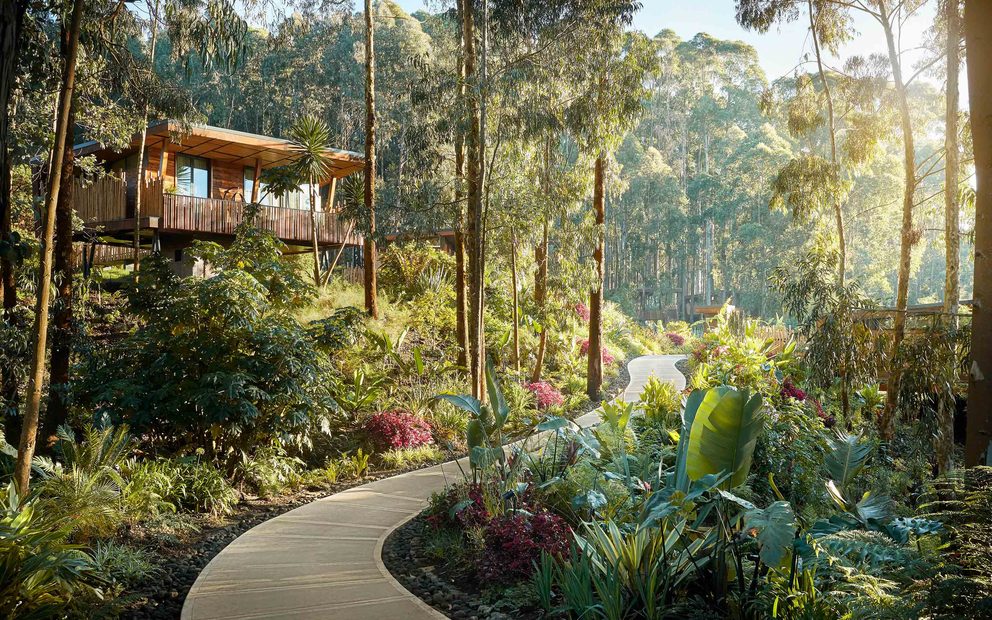
Private cottages, panoramic forest views, sophisticated meals, fireplaces and highly personalised service can be particularly enjoyable after a long day trekking.
There is something deeply satisfying about returning from the forest, removing muddy boots, taking a hot shower and relaxing while looking back toward the hills where you have just seen gorillas.
However, luxury does not compensate for poor geography.
A spectacular lodge several hours from your trekking starting point may be less appropriate than a simpler property in the correct location.
This is why Buutu Safaris matches accommodation with both the permit and the surrounding itinerary.
Should You Stay One or Two Nights in Bwindi?
For one gorilla trek, two nights is usually a sensible minimum.
You arrive during the afternoon or evening before trekking and sleep near the park.
The following morning you trek the gorillas and then return to the lodge.
Spending another night after the trek allows you to relax and absorb the experience. Leaving immediately after a demanding trek is possible in some itineraries but can make the day feel unnecessarily rushed.
You may return muddy and tired.
Having time for a shower, a meal and a quiet evening looking through photographs is often greatly appreciated.
Travellers doing two gorilla treks should generally consider three nights.
Can Children Go Gorilla Trekking?
Gorilla trekking has a minimum age requirement, generally 15 years in Uganda & Rwanda.
Families with younger children can still enjoy a remarkable Uganda safari.
One solution is for parents to trek on different days while the other parent remains with younger children.
Another option is to structure the holiday around activities that the whole family can enjoy together and add gorilla trekking for eligible family members.
Uganda’s national parks provide excellent family wildlife viewing from safari vehicles and boats.
Children can see elephants, giraffes, hippos, buffaloes, monkeys and numerous other animals without needing to participate in the gorilla trek.
Families should always provide children’s ages during the planning process.
Is Gorilla Trekking Worth the Money?
For most travellers who are passionate about wildlife, gorilla trekking is worth the cost.
There is no need to pretend it is inexpensive.
The permit represents a significant investment, particularly when combined with international travel.
However, value should not be measured only by the number of minutes spent with the gorillas.
The permit gives controlled access to one of the rarest wildlife experiences on Earth. It also supports a conservation system involving rangers, trackers, monitoring and the protection of the forest itself.
Tourism also creates employment throughout communities surrounding the protected areas. Guides, porters, drivers, lodge staff, farmers, craft producers and numerous other people participate directly or indirectly in the tourism economy.
The experience itself is difficult to compare with ordinary sightseeing.
You are not buying a performance. You are being given limited access to the habitat of a wild great ape.
For many of our guests, the encounter becomes one of the strongest memories of their lives.
How Does Gorilla Tourism Help Conservation?
Mountain gorillas survive because their habitat is protected and because substantial resources are invested in conservation.
Tourism can help generate those resources.
Permit revenue contributes to protected-area management, while the broader tourism economy creates jobs around the forests.
Community participation is particularly important. National parks cannot exist successfully as isolated islands surrounded by communities that receive no benefits from conservation. People living beside wildlife inevitably experience costs as well as benefits.
Land is limited. Animals can sometimes move beyond protected boundaries. Agricultural pressure can increase.
Tourism can help create an economic reason for maintaining the forest.
Hiring porters, staying in locally connected lodges, buying community products and using responsible local operators all help broaden the economic footprint of conservation tourism.
This does not mean tourism solves every environmental challenge.
It does mean that well-managed tourism can make living gorillas economically more valuable than a destroyed forest.
Is Gorilla Trekking Ethical?
Gorilla trekking can support conservation when it is carefully managed.
The ethical foundation depends on limiting visitor numbers, controlling human behaviour and prioritising gorilla welfare above tourist convenience.
This is why the rules matter.
A visitor who attempts to approach closer than instructed because they paid for an expensive permit misunderstands the nature of the experience.
The permit does not purchase control over the animal. It gives permission to enter the gorilla’s environment under conservation conditions. Health regulations also matter because gorillas are biologically close to humans and can be vulnerable to human illnesses.
Responsible tourism sometimes requires accepting inconvenience.
If rangers tell you not to do something, the correct response is to respect the rule even if breaking it might produce a better photograph.
In conservation tourism, the welfare of the animal must always come before the visitor’s social media account.
Why Should You Book With a Local Uganda Safari Company?
Gorilla safaris contain many moving parts.
The permit determines the trekking sector.
The sector affects accommodation.
Accommodation influences transfer times.
The day before the gorilla trek may determine which side of Bwindi you should approach.
The day after the trek may influence whether you continue toward Queen Elizabeth, Lake Bunyonyi, Mgahinga, Rwanda or an airstrip.
A booking platform can sell you a room. What it may not explain is whether that room makes sense within your actual route.
Local operators like us work with these distances repeatedly. We understand that locations appearing close on an online map can require surprisingly long journeys through mountainous terrain.
We can also coordinate several different elements of the safari at once.
At Buutu Safaris, we can arrange gorilla permits, chimpanzee permits, private safari vehicles, driver-guides, accommodation, domestic flights and additional wildlife activities as part of one journey.
Why Choose Buutu Safaris for Gorilla Trekking?
Buutu Safaris is a locally owned Uganda safari company with decades of experience in East African tourism.
Our approach to gorilla safaris is based on local knowledge rather than simply selling a standard itinerary.
We begin by understanding what the guest actually wants.
For some visitors, gorillas are the entire purpose of the journey and everything else should support that experience.
For others, the gorilla trek is one part of a wider safari involving chimpanzees, lions, elephants, the Nile or the Serengeti.
Those travellers should not receive the same itinerary.
We also understand the geography behind gorilla trekking. Selecting the correct trekking sector, accommodation and transport route can dramatically improve the safari.
Our locally based team can help arrange Uganda-only journeys as well as combinations with Rwanda, Kenya and Tanzania.
The objective is straightforward: create a safari that works in reality, not merely one that looks good on paper.
Can Gorilla Trekking Be Combined With Lake Bunyonyi?
Yes. Lake Bunyonyi is particularly convenient for travellers visiting southern Bwindi.
The lake is surrounded by steep cultivated hills and numerous islands, creating a peaceful contrast to the intensity of gorilla trekking.
After several hours climbing through the forest, spending time beside the water can be extremely relaxing.
Visitors can enjoy boat trips, kayaking, community experiences or simply slow down and appreciate the scenery.
Lake Bunyonyi also supports local livelihoods through fishing, farming and tourism.
It can be incorporated naturally between Bwindi and other parts of Uganda.
Can You Combine Gorilla Trekking With Kenya or Tanzania?
Yes, and these combinations can produce some of Africa’s greatest wildlife journeys.
Uganda provides the forest and primate experience while Kenya or Tanzania introduces the great savannah ecosystems.
A traveller might begin with mountain gorillas in Bwindi and then fly toward the Masai Mara.
Another might combine gorillas with the Serengeti and Ngorongoro Crater.
The contrast is enormous.
In Uganda you may spend a morning walking beneath dense rainforest canopy.
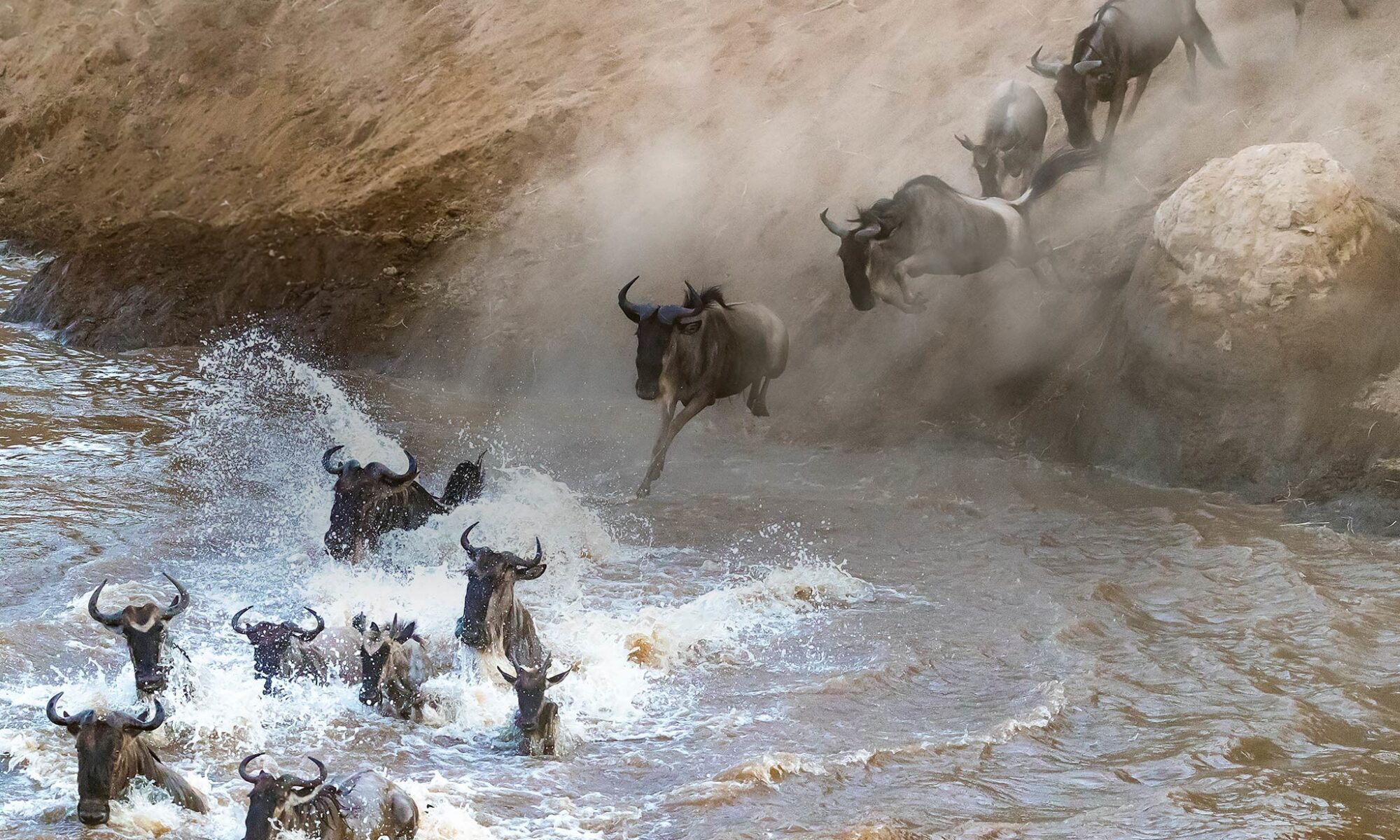
Several days later you could be watching lions cross open grassland while thousands of wildebeest move across the horizon.
For travellers visiting East Africa from North America, Europe, Asia or Australia, combining these destinations can make excellent use of a long international journey.
Are Mountain Gorillas Only Found in Uganda?
No.
Wild mountain gorillas survive in two main landscapes in this part of Africa.
One is Bwindi Impenetrable National Park. The other is the Virunga mountain ecosystem extending across Uganda, Rwanda and the Democratic Republic of Congo.
This extremely limited natural range is part of what makes mountain gorillas so special. They cannot be seen naturally in Kenya, Tanzania, South Africa or the majority of other African safari destinations.
Anyone wishing to see wild mountain gorillas must travel to this small region of Africa.
Are Gorillas Monkeys?
No.
Gorillas are great apes.
The great apes include gorillas, chimpanzees, bonobos, orangutans and humans.
The connection becomes surprisingly obvious during a gorilla encounter.
It is not simply their physical appearance.
Their hands, facial expressions, social relationships and interaction with young animals can feel remarkably familiar.
This sense of recognition is one reason people frequently describe gorilla trekking as emotional rather than merely exciting.
Watching a lion is thrilling.
Looking into the face of a gorilla can create a different reaction altogether.
What Is a Silverback Gorilla?
A silverback is an adult male gorilla that has developed the distinctive silver-grey colouring across its back.
Within a gorilla family, a dominant silverback often has an extremely important social role.
He may influence where the family moves, protect members from threats and intervene during conflicts.
His physical size can be astonishing.
Photographs rarely communicate the impression created by seeing those shoulders and arms at close range.
Yet visitors are often equally surprised by the calmness of the animal.
The silverback may spend most of the encounter feeding quietly, apparently uninterested in the group of excited humans nearby.
This contrast between immense physical strength and relaxed behaviour makes silverbacks particularly fascinating to observe.
What Do Mountain Gorillas Eat?
Mountain gorillas eat a largely plant-based diet.
They consume leaves, stems, shoots and numerous other forms of vegetation available within their habitat.
Watching them feed is more interesting than it may initially sound.
Their hands manipulate vegetation with remarkable precision.
A gorilla may pull a plant toward itself, remove the less desirable parts and eat selected sections with a deliberate efficiency that reflects years of familiarity with the forest.
Feeding also creates social interaction as different members of the family move around one another.
Young gorillas frequently appear more interested in playing than eating, while adults may feed methodically for long periods.
What Is a Gorilla Family?
Gorillas live in social groups often described as families.
A group may contain a dominant silverback, adult females, younger males, juveniles and infants.
Family size and composition can change over time.
Young males mature, individuals move between groups, infants are born and older gorillas eventually die.
This means information about individual families can quickly become outdated.
Online lists describing exact group composition from several years ago should therefore not be treated as permanent.
Your rangers and the park authorities will have the most relevant information about the family assigned on the day of your trek.=
Will You Definitely See Gorillas?
Gorilla trekking generally has a very high success rate because habituated families are monitored by trackers.
However, these remain wild animals.
No responsible operator should promise a wildlife sighting with absolute certainty.
The gorillas are not contained within an enclosure.
They move according to food availability, social relationships and their own natural behaviour.
Trackers use their knowledge of the previous day’s movements and signs in the forest to locate them.
The uncertainty is actually part of what makes trekking different from visiting captive wildlife.
You have to find the animals in their own environment.
Does Gorilla Trekking Take All Day?
It can. Some visitors locate their gorilla family relatively quickly and return to the lodge before lunch. Others may spend many hours in the forest.
For planning purposes, the gorilla trek should be considered the primary activity of the day.
Avoid arranging an important afternoon activity that depends on returning at a specific time.
If you finish early, the extra time becomes a pleasant bonus.
If the trek is long, you will be grateful that nothing else was scheduled.
What Happens If It Rains During Gorilla Trekking?
Rain is part of the experience.
Bwindi is a rainforest and showers can occur even when the morning begins with clear skies.
A lightweight waterproof jacket is therefore essential.
Camera equipment and important personal items should also be protected.
Rain can make the trail more difficult because mud develops rapidly on steep slopes.
Walk slowly and accept help from your porter.
Interestingly, rain can also produce some of the most beautiful forest conditions.
The vegetation becomes saturated, mist may appear and the entire landscape takes on a darker, richer appearance.
The memory of meeting gorillas in a rain-soaked forest can be extraordinary.
What If You Become Sick Before Gorilla Trekking?
Tell your ranger guide.
Do not hide illness simply because you have paid for an expensive permit.
Gorillas are closely related to humans and disease transmission is a serious conservation concern.
Park authorities may restrict participation when a visitor has symptoms of a communicable illness.
Rules should always be confirmed according to current park regulations.
The principle is straightforward.
The health of the gorillas takes priority over the visitor’s desire to complete the trek.
Do You Need Travel Insurance for Gorilla Trekking?
Comprehensive travel insurance is strongly recommended for any Uganda safari.
Travellers should check that their policy is appropriate for the activities included in the itinerary.
Coverage can differ substantially between insurance providers.
Medical treatment, evacuation, cancellation, baggage and unexpected disruption are all worth considering.
Travellers with pre-existing medical conditions should pay particular attention to policy terms.
Insurance is one of those things you hope never to use, but it becomes extremely important if something unexpected happens.
Do You Need Vaccinations for Gorilla Trekking in Uganda?
Travel health recommendations and entry requirements can change.
Travellers should seek up-to-date advice from qualified medical professionals and official health authorities before travelling.
This should be done well in advance because some preventative measures may require time.
Do not rely entirely on an old safari blog when making health decisions.
A page written several years ago may contain requirements that have since changed.
What Should You Know About Altitude?
The gorilla regions of south-western Uganda are mountainous.
Visitors arriving from lower elevations may notice that walking uphill feels more demanding than expected.
Most healthy travellers adapt without difficulty, but hydration and sensible pacing are important.
The effects of altitude become more noticeable when combined with steep terrain and physical exertion.
Travellers with medical conditions that could be affected by altitude or strenuous exercise should discuss the journey with an appropriate healthcare professional.
Is Tipping Expected During Gorilla Trekking?
Tipping is generally appreciated for good service but should remain voluntary.
Porters, guides and other staff often play a major role in making the experience successful.
Your safari guide can provide information about current local practices.
Carrying suitable cash can make tipping easier.
The important thing is not to become anxious about exact amounts.
A tip should represent appreciation for service rather than becoming another complicated obligation.
What Else Can You Do in Bwindi?
Bwindi is far more than a place to see mountain gorillas.
It is one of Africa’s great mountain forests and contains extraordinary biological diversity.
Travellers with additional time can explore the forest through guided walks, birdwatching and other nature experiences.
The surrounding communities also provide opportunities to understand the human landscape around the protected area.
This broader perspective is important.
The forest does not exist separately from the communities around it.
People farm the surrounding hills, operate lodges, work as guides and porters and participate in numerous tourism enterprises.
Spending additional time around Bwindi allows travellers to understand the destination rather than simply arriving, seeing gorillas and leaving immediately.
What Else Can You Do in Mgahinga?
Mgahinga is particularly attractive to active travellers.
Golden monkey tracking provides an opportunity to experience another endangered primate within the bamboo forests.
Volcano hiking can take visitors onto the slopes of the Virunga mountains.
Birdwatching is also rewarding.
The combination of gorillas, golden monkeys and mountain scenery makes Mgahinga an excellent destination for travellers who want to spend several days in one region rather than constantly moving between national parks.
How Should You Plan a Gorilla Safari?
The first stage is deciding approximately when you want to travel.
Exact dates are helpful, but even knowing the month gives a safari planner somewhere to begin.
The next consideration is the number and ages of travellers.
Age matters because of the minimum age requirement for gorilla trekking.
The third question is what you want the trip to include beyond gorillas.
Some travellers want nothing more than one excellent gorilla encounter.
Others want chimpanzees.
Some want lions and elephants.
Others want to continue to Rwanda, Kenya or Tanzania.
Your available time then shapes what is realistic.
A four-day safari cannot comfortably contain the same experiences as a ten-day journey.
Accommodation preferences and budget should also be discussed early.
Once those factors are understood, gorilla permit availability can be checked and an appropriate sector identified.
The rest of the itinerary should then be built around that permit.
This approach creates a much more coherent safari than simply adding activities one at a time.
What Is a Good Three-Day Gorilla Safari?
A three-day safari is the fastest conventional way to experience Uganda’s mountain gorillas when travelling by road.
The first day involves the journey from the Entebbe or Kampala region toward Bwindi.
The second day is dedicated to gorilla trekking.
The third day is the return journey.
This itinerary is best suited to travellers with very limited time.
It delivers the gorilla experience but does not provide much opportunity to explore Uganda’s other wildlife destinations.
What Is a Good Four-Day Gorilla Safari?
Four days provides greater flexibility.
The itinerary can potentially combine gorilla trekking with another experience such as Lake Bunyonyi or limited traditional wildlife viewing, depending on routing.
The extra day also reduces the feeling of spending the entire safari travelling.
For travellers on a short East African holiday, four days can represent a useful compromise between time and experience.
Is Six Days Enough for Gorillas and Chimpanzees?
A six-day itinerary can combine mountain gorillas and chimpanzees when carefully designed.
Kibale National Park provides the chimpanzee experience while Bwindi provides the gorillas.
Queen Elizabeth National Park can sometimes be included between them, introducing traditional game viewing.
This type of itinerary is extremely attractive because travellers experience two great ape species and several distinct ecosystems within less than a week.
What About a Seven-to-Ten-Day Uganda Safari?
Seven to ten days is where Uganda begins to reveal its full diversity.
Chimpanzees can be combined with Queen Elizabeth National Park, Bwindi and additional wildlife experiences.
There is more time for boat safaris, game drives and scenic stops.
The itinerary also becomes less rushed.
For many international travellers, this is the ideal range for a first Uganda safari.
Can You Combine Gorillas With Murchison Falls?
Yes.
Murchison Falls creates a fascinating contrast with Bwindi.
At Murchison, the Nile passes through savannah country supporting giraffes, elephants, buffaloes, antelopes and predators before being forced dramatically through the famous waterfall gorge.
Bwindi is completely different.
The open landscape disappears and is replaced by mountain rainforest and primates.
Combining the two demonstrates the extraordinary ecological variety found within Uganda.
Why Is Gorilla Trekking Different From an Ordinary Safari?
Traditional safari is fundamentally an act of observation from a distance.
You usually sit inside a vehicle while animals move through the landscape.
Gorilla trekking changes the relationship.
You have to walk.
The forest surrounds you.
You feel the gradient of the mountain, the mud beneath your boots and the humidity in the air.
You hear birds and insects long before you see the animal you came for.
Finding the gorillas requires physical participation.
Then, when you finally reach them, there is no vehicle separating you.
That physical and emotional proximity creates an experience unlike ordinary game viewing.
Why Do People Find Gorilla Trekking Emotional?
Part of the answer lies in familiarity.
A lion is obviously a magnificent animal, but it feels very different from us.
A gorilla can look strangely familiar.
Hands manipulate vegetation.
A mother holds an infant.
Young animals play.
Adults communicate through gesture and expression.
Their eyes can give the impression of observation rather than simply reaction.
Humans naturally recognise elements of ourselves within that behaviour.
Then there is the knowledge that mountain gorillas survive only within a small region of Africa.
You are not simply looking at an animal.
You are seeing a species whose continued survival has required decades of conservation.
Those factors combine to produce an encounter that many travellers struggle to describe afterwards.
Final Advice for Planning Gorilla Trekking in Uganda
The most important advice is to avoid treating gorilla trekking as a simple ticket purchase.
The permit, trekking sector, accommodation and wider itinerary all need to work together.
Book early when your travel dates are fixed.
Stay near the correct trekking headquarters.
Prepare physically for the walk without becoming unnecessarily worried about it.
Wear good boots.
Hire a porter.
Protect your camera from rain.
Follow your ranger.
Most importantly, remember that the purpose of the experience is not simply to obtain photographs.
The greatest moment often comes when you stop taking pictures.
You are sitting inside one of Africa’s oldest forests.
Leaves move above you.
Somewhere close by, an infant climbs onto its mother.
A juvenile disappears behind a tree.
Then an enormous silverback raises his head and looks in your direction.
For a few moments, the normal boundary between human traveller and wilderness becomes remarkably thin.
That is what people travel thousands of kilometres to experience.
Uganda gives travellers the opportunity to do something even more remarkable: to place that encounter within a larger journey through chimpanzee forests, savannahs, mountains, wetlands, lakes and the Nile.
A gorilla trek can therefore become more than the highlight of a safari.
It can become the reason you remember Uganda for the rest of your life.
Plan Your Uganda Gorilla Trekking Safari With Us
We specialise in tailor-made gorilla trekking and wildlife safaris throughout Uganda and East Africa.
Whether you want a short gorilla trekking safari, a combined gorilla and chimpanzee journey, a luxury fly-in safari, a family adventure or a longer itinerary connecting Uganda with Rwanda, Kenya or Tanzania, we can design the journey around your interests, available time and budget.
Our local knowledge helps ensure that your gorilla permit, trekking sector, lodge and safari route work together properly.
A Guide to Gorilla Trekking in Rwanda
Gorilla trekking in Rwanda takes place in Volcanoes National Park, in the north-west of the country near Musanze. The park forms part of the Virunga Massif and protects a spectacular landscape of bamboo forest, montane vegetation and volcanic mountains, including Karisimbi, Bisoke, Sabyinyo, Gahinga and Muhabura. Rwanda is particularly attractive for travellers who want a short gorilla safari because Volcanoes National Park can be reached from Kigali in roughly three hours by road.
The gorilla trekking experience begins early in the morning at the park headquarters, where visitors are briefed before being assigned to a habituated gorilla family. The trek can take anywhere from around 90 minutes to much of the morning depending on the location of the gorillas and the terrain. Once the family is located, visitors are allowed to spend approximately one hour observing the gorillas as they feed, rest, groom and interact.
A standard Rwanda gorilla trekking permit currently costs US$1,500 per person per trek, and the minimum trekking age is 15 years. Special rates are available for some Rwandan, East African and resident categories. Because permits are limited, advance booking is recommended, particularly during popular travel periods.
Gorilla trekking can be physically demanding because the Virunga terrain can be steep, muddy and uneven. Travellers should wear sturdy walking boots, long trousers and protective clothing, and carry a lightweight waterproof jacket. Gaiters and gloves can also be useful. Hiring a porter is highly recommended, both for carrying equipment and for assistance on steep or slippery sections of the trail.
One of Rwanda’s greatest advantages is how easily gorilla trekking can be combined with other experiences. Visitors can track golden monkeys, hike Mount Bisoke or Mount Karisimbi, explore Musanze, visit Lake Kivu or continue to Akagera National Park for a traditional wildlife safari. Rwanda therefore works particularly well for travellers looking for a compact, premium gorilla-focused journey.
For travellers comparing Rwanda and Uganda for gorilla trekking, Rwanda generally offers easier access and is particularly suited to shorter itineraries, while Uganda offers two gorilla parks and greater flexibility for combining gorillas with chimpanzee trekking and extended wildlife safaris. Both destinations provide exceptional mountain gorilla encounters, and Buutu Safaris can also combine Rwanda and Uganda within one tailor-made East African journey.
When you are ready to start planning, tell us your preferred travel dates, number of travellers, approximate safari length and the experiences you would most like to include.
We will take it from there.